Contact center of the Ukrainian Judiciary 044 207-35-46
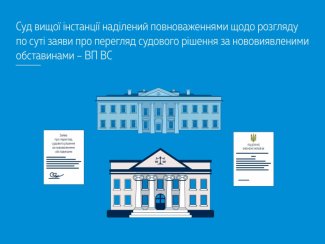
A court of appeal or cassation has the authority to set aside a decision of a lower court and adopt a new judicial decision following the examination of an application for review of a relevant judgment based on newly discovered circumstances, including dismissing such an application; that is, it may examine such an application on the merits.
These conclusions were made by the Grand Chamber of the Supreme Court.
In the case under consideration, the court of first instance granted the application for review based on newly discovered circumstances of a judgment on the recovery of debt under a credit agreement, set it aside, and adopted a new decision dismissing the claim. By its ruling, the appellate court set aside the decision of the court of first instance and adopted a new judicial decision dismissing the application for review based on newly discovered circumstances, thereby leaving the original judgment in force.
The Grand Chamber of the Supreme Court was faced with the question of whether a higher court has the authority to set aside a decision of a lower court and adopt a new judicial decision following the consideration of an application for review based on newly discovered circumstances, including dismissing such an application, i.e. to examine such an application on the merits.
The Grand Chamber emphasized that a review of judicial decisions based on newly discovered circumstances is a type of review in which there is no judicial error in the initial consideration of the case, and the newly discovered circumstances are objective in nature. For this reason, the power to conduct such a review belongs not to a higher court, as is the case with appellate and cassation review, but to the court that delivered the judgment on the merits.
The court that rendered the decision is able, on the basis of the Civil Procedure Code of Ukraine, to determine whether its judgment was erroneous or correct by assessing the impact of the newly discovered circumstances.
The appellate court, for its part, when reviewing (on appeal) the legality and soundness of a first-instance decision adopted after considering an application for review based on newly discovered circumstances, assesses, among other things, whether such circumstances actually existed and whether they justify reopening the case. If the first-instance court made erroneous findings regarding the existence of such circumstances, the appellate court must correct that error, including, where appropriate, by issuing its own decision on the application.
During cassation review of judicial decisions concerning the granting of an application for review of a judgment based on newly discovered circumstances, the court of cassation may assess the presence or absence of such circumstances and, accordingly, adopt a new judicial decision on the application for review based on newly discovered circumstances, including dismissing it.
Thus, the Grand Chamber of the Supreme Court agreed with the appellate court, which, having found the conclusions of the court of first instance regarding the existence of newly discovered circumstances in this case to be incorrect, rectified the relevant judicial error (in particular, by adopting its own decision on the application).
Resolution of the Grand Chamber of the Supreme Court of 14 January 2026 in case No. 361/161/13-c (proceedings No. 14-35цс25): https://reyestr.court.gov.ua/Review/133908580.
This and other legal positions of the Supreme Court can be found in the Database of Legal Positions of the Supreme Court - https://lpd.court.gov.ua.
_03_03.png)