Contact center of the Ukrainian Judiciary 044 207-35-46
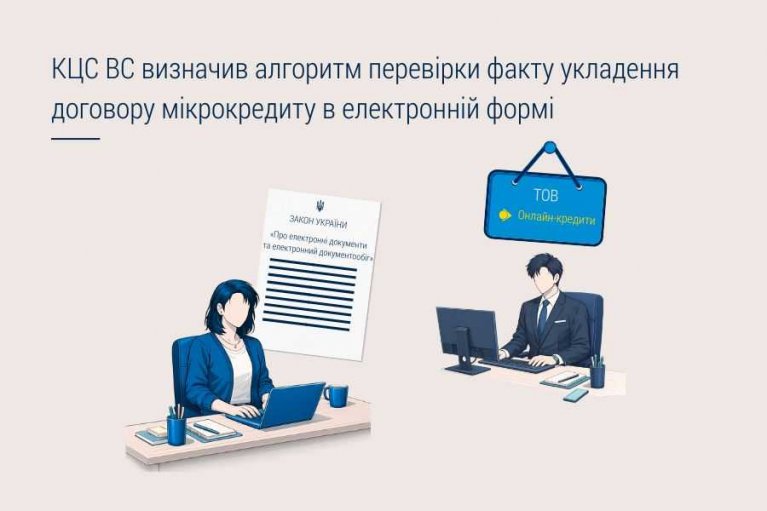
The possibility for a court to verify the authenticity, integrity, and immutability of an electronic document depends primarily on the type of signature used to sign it. The court verifies the authenticity, integrity, and immutability of an electronic document signed with a qualified or improved electronic signature through special software or online services. Documents signed with a different type of electronic signature require additional procedural actions to confirm their integrity, in particular, clarification of the method of sending, the storage format, and the possibility of unilateral changes. A paper copy of an electronic evidence is accepted by the court if there are no doubts regarding its compliance with the original.
These conclusions were reached by the Supreme Court in the panel of judges of the First Judicial Chamber of the Civil Cassation Court.
In the case under review, the creditor company filed a lawsuit against the respondent for the recovery of debt under a loan agreement, claiming that a loan agreement had been concluded between them, under which the claimant provided the respondent with monetary funds. The claimant asserted that due to the respondent’s improper performance of her obligations under the loan agreement, a debt had arisen for the principal amount of the loan and accrued interest.
The court of first instance granted the claim partially, recovering the loan debt from the respondent in favour of the claimant, reasoning that the fact of the respondent receiving the loan funds had not been refuted, and the loan agreement concluded in electronic form was valid.
The appellate court agreed with the conclusions of the court of first instance regarding the satisfaction of the creditor company’s claims, referring to the proven fact of the conclusion of a loan agreement between the parties in electronic form. At the same time, the appellate court overturned the decision of the court of first instance in the part denying the claim for recovery of interest for the use of the loan funds and granted this claim of the claimant, citing the respondent’s failure to dispute the debt calculation and her failure to provide evidence of compliance with the terms of the agreement.
When overturning the adopted court decisions and remanding the case for a new trial upon the respondent’s cassation appeal, the Civil Cassation Court of the Supreme Court made the following legal conclusions.
The Supreme Court noted that relations arising in the process of creation, sending, transmission, receipt, storage, processing, use, and destruction of electronic documents are governed by the Law of Ukraine “On Electronic Documents and Electronic Document Management”.
According to Article 7 of the Law of Ukraine “On Electronic Documents and Electronic Document Management”, the original of an electronic document is considered to be the electronic copy of the document containing the mandatory requisites, including the electronic signature of the author or a signature equivalent to a handwritten signature in accordance with the Law of Ukraine “On Electronic Identification and Electronic Trust Services”.
The Supreme Court noted that the use of a one-time identifier signature is provided for by the Law of Ukraine “On Electronic Commerce”, which also contains its definition.
Pursuant to Clause 6, Part 1, Article 3 of the Law of Ukraine “On Electronic Commerce”, an electronic signature with a one-time identifier is data in electronic form in the form of an alphanumeric sequence added to other electronic data by the person who accepted the offer to conclude an electronic agreement and sent to the other party to this agreement.
In fact, since the legislation does not require electronic agreements to be signed with types of signatures that ensure the immutability of their content (QES or AES), the issue of compliance with the written form when concluding them boils down to whether the content of these agreements can be considered fixed (the requirement of Part 1 of Article 207 of the Civil Code of Ukraine).
However, the absence of substantive legal requirements for fixing the content of an electronic agreement does not mean that this issue can be ignored during court proceedings.
The courts of previous instances committed a violation of the rules of procedural law that affects the correctness of the dispute resolution, since all conclusions in the case are based on the examination of copies of evidence, which, according to the claimant-creditor, prove the fact of concluding an electronic loan agreement between the parties and the actual transfer of funds to the respondent, who questioned the evidence provided by the claimant both in the court of first instance and in the appellate court. None of the courts fulfilled the requirements of Article 95 of the Civil Procedure Code of Ukraine and did not request the originals of the electronic evidence from the applicant, despite the respondent’s motions, without providing any justification for this. In the opinion of the Civil Cassation Court of the Supreme Court, this constitutes a violation of the principle of adversarial proceedings of the parties.
The Civil Cassation Court of the Supreme Court emphasized that the possibility for the court to verify the authenticity, integrity, and immutability of an electronic document depends primarily on the type of signature with which it was signed. If the electronic document is signed using a Qualified Electronic Signature (QES) or an Advanced Electronic Signature (AES), the court may verify the authenticity, integrity, and immutability of the data contained therein through special software or special online services.
The specific actions required depend on the method of submitting the relevant procedural document to the court (paper copy, electronic copy, etc.), the format in which the document is stored, the features of the electronic signature with which it was signed, and other factors. The nature of these procedural actions is determined by the specifics of examining electronic evidence as provided for by procedural legislation.
In the absence of copies of the electronic loan agreement signed with a QES or AES (where the electronic document is signed with any other type of electronic signature), the court must verify the integrity and immutability of the document by clarifying whether the agreement was sent to the respondent, in what form (as a file or a link), and whether there was a technical possibility for its unilateral editing. This is precisely what the respondent had pointed out.
The cassation court noted that posting the agreement via a link in a simple PDF format does not constitute confirmation of the integrity and immutability of the text of this agreement, since this format allows the owner of the webpage (site) to make unilateral changes. However, if the agreement was sent to the respondent as an attached PDF file from the claimant’s email address, which clearly identifies it as the claimant’s address, and the text of the letter and its attachments cannot be technically altered, then this constitutes proper confirmation of the integrity and immutability of the electronic document.
Resolution of the Civil Cassation Court of the Supreme Court dated February 4, 2026, in case No. 758/14925/23 (proceedings 61-4523св25) — https://reyestr.court.gov.ua/Review/133947146.
This and other legal positions of the Supreme Court can be found in the Database of Legal Positions of the Supreme Court - https://lpd.court.gov.ua.
_03_03.png)