Contact center of the Ukrainian Judiciary 044 207-35-46
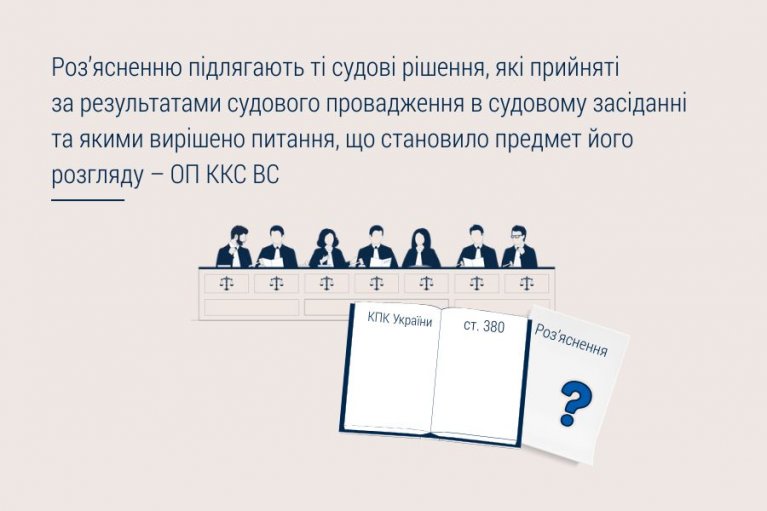
Applications for clarification of such decisions must be examined by the court in a separate court hearing after notifying the person who submitted the application and the participants in the proceedings, and, following the consideration, the court shall issue a ruling either clarifying the judicial decision or refusing such clarification.
If, however, the applicant seeks clarification of a judicial decision that was not the result of court proceedings and did not constitute the subject matter of consideration, the court, upon examining such an application, shall issue a ruling on clarification or refusal without scheduling a court hearing.
The question of whether a judicial decision was adopted as a result of court proceedings, i.e., whether it constituted the subject matter of consideration, shall be resolved by the court with due regard to the grounds for initiating and conducting the specific proceedings.
If the applicant requests clarification of a judicial decision that is not an independent subject of clarification under the procedure established by Article 380 of the Criminal Procedure Code of Ukraine, since it is not the result of judicial consideration, the appellate court has the right to refuse to open appellate proceedings or to close such proceedings if they were opened on the basis of an appeal against a ruling of a local court issued following the consideration of such an application.
These conclusions were reached by the Joint Chamber of the Criminal Cassation Court within the Supreme Court following the consideration of case No. 766/2466/24.
According to the circumstances of the criminal proceedings, the local court, without retiring to the deliberation room, issued a ruling recorded in the court hearing log, by which it refused to clarify its earlier ruling extending the term of the accused’s detention in custody. Disagreeing with this ruling, the accused filed an appeal. The appellate court closed the appellate proceedings on the grounds that the appeal was filed against a judicial decision not subject to appeal. In the cassation appeal, the accused argued that the appellate court failed to take into account the provisions of Article 380 of the Criminal Procedure Code of Ukraine, which provide for the right to appeal such categories of judicial decisions, thereby committing a substantial violation of the requirements of the Code.
Assessing these cassation arguments, the Joint Chamber of the Criminal Cassation Court of the Supreme Court indicated that, in this case, the applicant requested clarification of a ruling of the local court concerning detention in custody, which had been issued during the examination of the case on the merits. That is, the subject matter of the court’s consideration was the question of the person’s guilt or innocence, taking into account related issues (such as limitation periods, pre-trial investigation time limits, etc.), and the result of such consideration is the issuance of a judgment or a ruling concluding the proceedings in the court of first instance. Therefore, a ruling extending the term of detention in custody, adopted during the trial, is not in this case a procedural decision that constituted the subject matter of the court’s consideration and was adopted as a result of such consideration.
Resolution of the Joint Chamber of the Criminal Cassation Court of the Supreme Court dated February 2, 2026, in case No. 766/2466/24 (proceedings No. 51-107кмо25) - https://reyestr.court.gov.ua/Review/133909925
This and other legal positions of the Supreme Court can be found in the Database of Legal Positions of the Supreme Court - https://lpd.court.gov.ua.
_03_03.png)