Contact center of the Ukrainian Judiciary 044 207-35-46
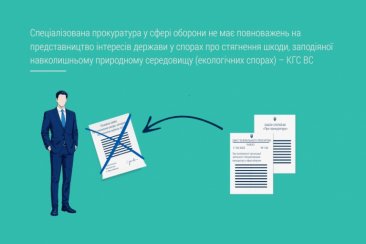
The Specialized Prosecutor's Office in the Defence Sector has no authority to represent the interests of the state in cases concerning environmental damage or the interests of local self-government bodies, as its competence is limited to legal relations in the sphere of defence and special state bodies. Subordinate legislation cannot expand an authority's powers beyond the limits established by law.
This conclusion was reached by the panel of judges of the Commercial Cassation Court within the Supreme Court.
The Deputy Head of the Ternopil Specialized Prosecutor's Office in the Defence Sector, acting in the interests of the state represented by the State Environmental Inspectorate and the city council, filed a claim against SE “Forests of Ukraine” seeking recovery of damage caused by illegal logging.
The commercial court left the claim without consideration, citing the lack of authority on the part of the Specialized Prosecutor's Office in the Defence Sector to apply to court in cases unrelated to the defence sector. The court of appeal quashed that ruling and remitted the case for consideration by the court of first instance, reasoning that Order No. 130 “On Specific Features of the Organisation of Activities of Specialized Prosecutor's Offices in the Defence Sector” is a subordinate act and does not restrict the prosecutor's powers as provided for by the Law of Ukraine “On the Prosecutor's Office”.
The CommCC within the Supreme Court stressed that specialized prosecutor's offices in the field of defence, established by orders of the Prosecutor General (in particular Orders No. 75 and No. 130), represent the interests of the state in the defence sphere only in relation to specified subjects, and not in legal relations concerning environmental protection or local self-government.
The panel of judges noted that Order No. 130 of the Prosecutor General, adopted pursuant to Article 9 of the Law of Ukraine “On the Prosecutor's Office”, remains in force and mandatory, as it does not contradict Articles 23 and 24 of the Law and is aimed at delineating the powers between specialised prosecutor's offices in the defence sector, district prosecutors’ offices, and regional prosecutors’ offices. Ignoring this order leads to overlapping competence and creates a risk of jurisdictional conflict between different prosecutorial bodies.
The Commercial Cassation Court of the Supreme Court confirmed that specialised prosecutor's offices in the defence sector are authorised to represent the interests of the state only in the spheres expressly defined by law and related to defence activities. Representation of state interests in cases concerning environmental protection or local self-government falls within the competence of territorial prosecutors’ offices, and not those specialised in the defence sector.
The cassation court agreed with the position of the court of first instance that, in the absence of authority to represent state interests, a claim filed by a specialised prosecutor's office in the defence sector is deemed to have been signed by a person without the requisite power, and such a claim must be left without consideration.
Following the review, the SC CommCC granted the cassation appeal, quashed the ruling of the court of appeal, and upheld the decision of the court of first instance.
Resolution of the Commercial Cassation Court of the Supreme Court dated 15 January 2026 in case No. 921/190/25 — https://reyestr.court.gov.ua/Review/133448195.
This and other legal positions of the Supreme Court can be found in the Database of Legal Positions of the Supreme Court - https://lpd.court.gov.ua.
_03_03.png)