Contact center of the Ukrainian Judiciary 044 207-35-46
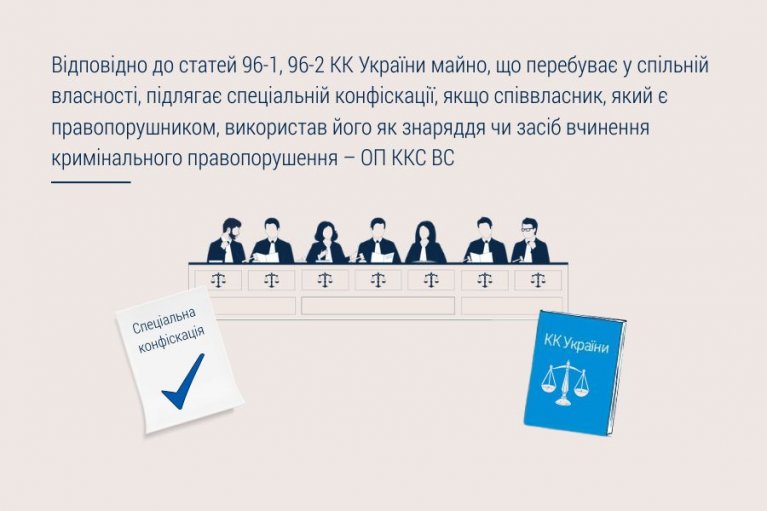
Where property used as an instrument or means of committing a criminal offence is jointly owned by spouses and has been used by one of them in the commission of a criminally punishable act, such property is subject to special confiscation in its entirety, since its owner (the spouse who committed the criminal offence) knowingly used it for unlawful purposes.
This conclusion was reached by the Joint Chamber of the Criminal Cassation Court within the Supreme Court following its consideration of case No. 669/338/24.
According to the circumstances of the criminal proceedings, the court of first instance found two defendants guilty and convicted them under Part 2 of Article 246 of the Criminal Code of Ukraine. The court ordered special confiscation and transferred to state ownership, without compensation, two wheeled tractors with a horse-drawn cart and two chainsaws belonging to the defendants. The court of appeal amended the judgment of the first-instance court and ordered the confiscation of a sum of money equivalent to the value of the property belonging to the defendants. In the cassation appeal, the defence argued that the tractors and chainsaw had been acquired during the defendant’s marriage and therefore constituted joint marital property. Accordingly, by ordering special confiscation of that property, which the defendant’s wife neither knew nor could have known was being used in the commission of a criminal offence, the courts had infringed her rights.
In assessing these cassation arguments, the Joint Chamber of the Criminal Cassation Court drew attention to the fact that the legislature has clearly specified in the Criminal Code the circumstances in which a monetary amount equivalent to the value of property used as an instrument or means of committing a criminal offence may be subject to special confiscation. In particular, Part 2 of Article 96-2 of the Criminal Code of Ukraine provides that where the confiscation of money, valuables, or other property referred to in Part 1 of that Article is impossible at the time the court decides on special confiscation due to their use, the impossibility of separating them from lawfully acquired property, their disposal, or for any other reason, the court shall order the confiscation of a monetary amount corresponding to the value of such property.
At the same time, the provisions of paragraph 4 of Part 1 of Article 96-2 of the Criminal Code of Ukraine clearly establish that where the owner (lawful possessor) was aware of the unlawful use of property subject to special confiscation, and especially where they personally used it as an instrument or means of committing an offence, this unequivocally precludes its return to other co-owners (including the other spouse), who are not mentioned in this context by the criminal law.
The provisions of the Criminal Code of Ukraine provide for the special confiscation of instruments and means used to commit a criminal offence, rather than a specific share thereof. Accordingly, there are no legal grounds for considering the return of such property subject to special confiscation to a co-owner who neither knew nor could have known of its unlawful use.
The Resolution of the Joint Chamber of the Criminal Cassation Court within the Supreme Court of 2 February 2026 in Case No. 669/338/24 (Proceedings No. 51-5214кмо24) is available at: https://reyestr.court.gov.ua/Review/133947342
This and other legal positions of the Supreme Court can be found in the Database of Legal Positions of the Supreme Court - https://lpd.court.gov.ua.
_03_03.png)