Contact center of the Ukrainian Judiciary 044 207-35-46
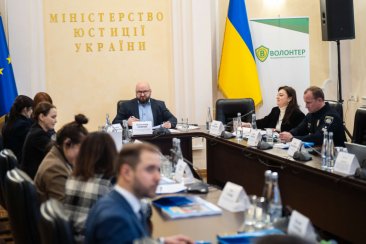
This was reported by judge of the Supreme Court in the Civil Cassation Court Pavlo Parkhomenko during a meeting of the Inter-Agency Coordination Council on Juvenile Justice (ICC) titled “Building a Child-Friendly Justice System in Ukraine: From Strategy to Action”. The meeting was also attended by Judges of the Grand Chamber of the Supreme Court Nadiia Stefaniv and Olha Buleiko.
The event aimed to summarize the activities of the ICC in 2025, discuss achievements, challenges, and systemic issues in developing a child-friendly justice system, as well as to form a shared vision and priorities for further work in the context of implementing the National Strategy for the Protection of Children’s Rights in the Justice Sector and Ukraine’s course toward European integration.
The discussion covered various aspects of child-friendly justice in both criminal and civil proceedings, as well as the experience of implementing the project on introducing specialization of judges in family and child matters. Pavlo Parkhomenko noted that plans are underway to expand the number of pilot courts, which may also include appellate courts. In addition, the Civil Cassation Court of the Supreme Court is currently examining the possibility of introducing such specialization.
The speaker pointed out that the ICC began its work in 2017. Since then, significant progress has been made in addressing various areas related to child-friendly justice. He emphasized that all issues concerning the protection of children’s rights within the justice system are closely interconnected. Protection in criminal proceedings and cases of administrative offences is particularly important. At the same time, during the war, the issue of protecting children’s rights in civil proceedings has become especially relevant, largely due to families with children leaving the country.
.jpg)
Pavlo Parkhomenko highlighted that cases involving children’s interests are among the most complex in civil proceedings. This is evidenced by numerous judgments of the European Court of Human Rights that have examined issues of child protection.
The judge recalled that in October 2024, the Civil Cassation Court of the Supreme Court became a co-organizer of the pilot project on introducing specialization of judges in family and child cases. In November of the same year, on the initiative of the Civil Cassation Court of the Supreme Court and the ICC, with the support of the United Nations Children’s Fund (UNICEF) in Ukraine and the NGO “Volunteer Humanitarian Center ‘Volunteer’”, a seminar was held to mark the launch of the pilot project on the specialization of judges in family and child cases.
Later, 10 pilot courts were selected in different regions of Ukraine, where the corresponding specialization of judges was introduced. It is also important that in May of last year, a Memorandum of Understanding was signed between the Supreme Court and the UNICEF Representation in Ukraine.
In January–February of last year, a specialized training program was developed for judges participating in the pilot project. The development involved judges from the Supreme Court and other instances, representatives of the National School of Judges of Ukraine, lawyers, child welfare specialists, representatives of children’s services, and psychologists. Following this, training was conducted, which included in-person meetings in courts and webinars.
Pavlo Parkhomenko noted that the training of multidisciplinary teams – which included judges, representatives of children’s services, psychologists, and other specialists – showed very good results. During these trainings, participants jointly discussed problems, searched for ways to solve them, and so on.
.jpg)
The speaker reported that, thanks to international partners, child-friendly spaces have been created in the courts. “Equipping child-friendly courtrooms under wartime conditions is our achievement,” he said.
In addition, methodological support was provided within the framework of the pilot project. A large number of materials were developed, including methodological recommendations on ascertaining the child’s opinion, as this is a very problematic issue. An algorithm for introducing court specialization was also developed.
The judge noted that discussions are ongoing in the Civil Cassation Court of the Supreme Court regarding the introduction of specialization at the cassation level. Within the project, further steps are being discussed for piloting the specialization of judges in appellate courts. “I think we will not stop at what has been achieved and will continue working in this direction,” said Pavlo Parkhomenko.
_03_03.png)