Contact center of the Ukrainian Judiciary 044 207-35-46
Digitalization of the judiciary, taking into account potential cyber threats and information security challenges, is a complex process even in peacetime; today, in the context of the full-scale war unleashed by Russia against Ukraine, the digitalization of the national justice system is particularly in need of support and assistance from international partners. Despite martial law, the Ukrainian judicial system continues to function, with approximately 5.3 million cases pending before courts of all instances and jurisdictions each year. Under such conditions, technological innovations in the administration of justice contribute to the optimisation and greater openness of judicial proceedings.
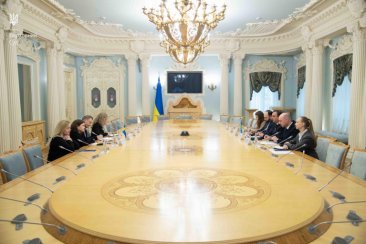
This was noted by the President of the Supreme Court, Stanislav Kravchenko, during a meeting with representatives of the Swedish International Development Cooperation Agency (SIDA) and the Agency for Legislative Initiatives. He thanked the Government of Sweden and SIDA for their consistent support of Ukraine during the war and, in particular, for the initiative to promote the development of the Unified Judicial Information and Communication System (UJICS) for all Ukrainian courts, which plays an important role in Ukraine’s further integration into the European space.
.jpg)
As the President of the Supreme Court reported, the Supreme Court is actively involved in digitalisation processes, including with a view to ensuring the uniformity of case law. Thus, last year, the functionality and search capabilities of the Database of Legal Positions of the Supreme Court were updated and improved by introducing generative artificial intelligence features. In addition, in February 2025, the Supreme Court and the European Court of Human Rights implemented a joint project to improve access to knowledge about ECHR case law in Ukraine: the Ukrainian-language version of the ECHR Knowledge Sharing Platform (ECHR-KS) was launched.
Malin Perhult, Head of SIDA’s Ukraine Support Unit, and Christina Danielsson, Counsellor, Head of Section for Reform Cooperation at the Embassy of Sweden in Ukraine, expressed solidarity with Ukraine at this defining moment and stressed that supporting Ukraine is currently a priority direction for the Government of Sweden. According to the international partners, it is important for the Swedish side to hear directly from the Ukrainian judicial system about its needs and expectations on the path towards further digitalisation of justice.
.jpg)
The Acting Chief of the Supreme Court Staff, Rasim Babanly emphasised that, thanks to the legislative expansion in 2023 of the potential for electronic document management in courts, the Supreme Court alone has saved approximately UAH 10 million on postal correspondence. The introduction of the Unified Judicial Information and Communication System (UJICS) as a standardised system for all courts will ensure prompt exchange of documents between courts and will enable the identification and resolution of problems in specific courts. The digitalisation of judicial proceedings will also free up judges’ time from routine work, allowing them to focus on considering complex cases. Moreover, the use of UJICS capabilities to ensure the uniformity of case law and effective judicial management is provided for in the Rule of Law Roadmap as one of the conditions for Ukraine’s successful European integration.
At the conclusion of the meeting, the SC President assured that the Supreme Court will continue to make every effort to fulfil the commitments undertaken under the Memorandum signed last October, which envisages the implementation of a project by the Agency for Legislative Initiatives and SIDA on the digitalisation of the judicial system in Ukraine.
The meeting was also attended by Vasyl Romaniuk, Project Cooperation Coordinator of the Section for Reform Cooperation at the Embassy of Sweden in Ukraine; Svitlana Matviienko, Executive Director of the Agency for Legislative Initiatives; Anastasiia Kulyk, Acting Head of the Division for International Cooperation; and Artem Nikolaienko, Chief Specialist of the Division for International Cooperation.
_03_03.png)