Contact center of the Ukrainian Judiciary 044 207-35-46
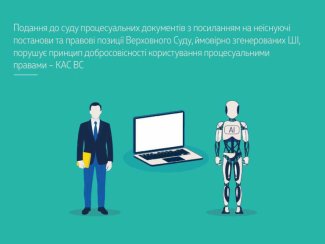
Parties to proceedings are required to observe the principle of professional human oversight when using artificial intelligence technologies.
References to non-existent Supreme Court resolutions may indicate that a party has used AI tools and received output in the form of so-called “hallucinations”, which demonstrates bad-faith exercise of procedural rights by that party.
These conclusions were set out by the Administrative Cassation Court of the Supreme Court in a ruling refusing to open cassation proceedings.
In the cassation appeal, the appellant relied – as grounds for challenging the decisions of the courts of first and appellate instance – on the alleged failure of those courts to take into account a number of Supreme Court resolutions. However, a check of the Unified State Register of Court Decisions established that none of the listed resolutions of the Grand Chamber of the Supreme Court or of the Supreme Court actually exists. In other words, the case numbers and dates of the alleged resolutions cited in the cassation appeal were fabricated, and the references to the legal positions supposedly formulated therein were false.
Such conduct contravenes the principle of good faith in the exercise of procedural rights enshrined in Article 45 of the Code of Administrative Procedure of Ukraine and casts doubt on the overall validity of the cassation appeal.
The Supreme Court noted that the nature of the cited references may indicate the use of artificial intelligence tools by the party, resulting in output containing “hallucinations” (a phenomenon in which generative AI systems produce inaccurate or fabricated information presented misleadingly as factual).
In this context, the Supreme Court emphasized that the use of AI to prepare procedural documents is not prohibited in itself. However, the sole responsibility for the accuracy of the information contained in procedural documents rests with the party to the proceedings.
The Supreme Court stressed the mandatory requirement of professional human-in-the-loop control. The use of AI in legal practice is permissible only as an auxiliary tool and cannot replace the professional activity of a lawyer: critical thinking, professional judgment, and legal qualification (Recommendations on the Responsible Use of Artificial Intelligence by Legal Professionals, approved by the Ministry of Digital Transformation and the Ministry of Justice of Ukraine, July 2025).
At the same time, the submission to a court of procedural documents generated by AI without proper professional verification constitutes improper performance of professional duties and bad-faith exercise of procedural rights by the party, which may be qualified as a manifestation of disrespect to the court.
Ruling of the Administrative Cassation Court of the Supreme Court dated January 15, 2026, in case No. 240/14153/24: https://reyestr.court.gov.ua/Review/133336040.
This and other legal positions of the Supreme Court can be found in the Database of Legal Positions of the Supreme Court - https://lpd.court.gov.ua.
_03_03.png)