Contact center of the Ukrainian Judiciary 044 207-35-46
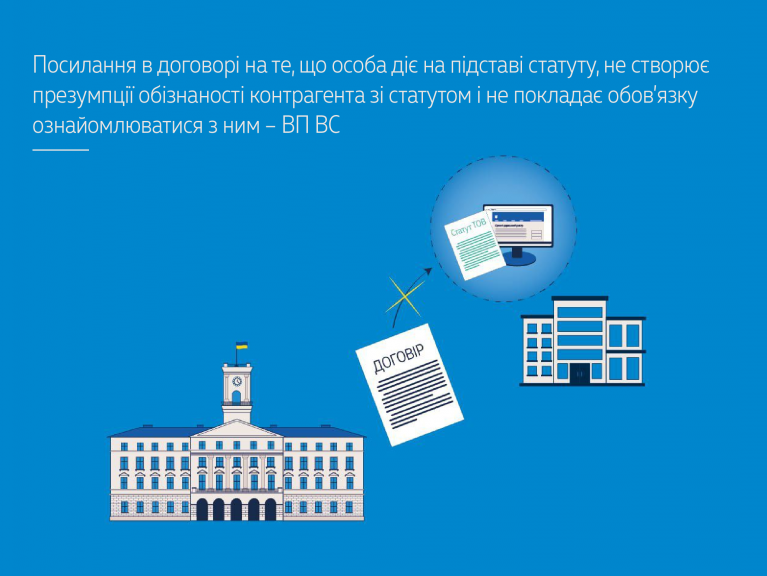
A reference in a contract to the fact that a person is acting on the basis of the company’s charter cannot be unconditionally equated with the third party (counterparty) having familiarized itself with the charter.
A bona fide counterparty of a legal entity has the right to rely and depend on the accuracy of the information entered into the Unified State Register of Legal Entities, Individual Entrepreneurs, and Public Formations, including information regarding the scope of authority of the head of the legal entity.
This is the conclusion of the Grand Chamber of the Supreme Court.
In accordance with the circumstances of the case and in compliance with the requirements of the Law of Ukraine “On Regulation of Urban Development”, an agreement on joint participation in the construction of a residential complex was concluded between the City Council’s Department of Economic Development and the limited liability company. However, the defendant failed to fulfill its obligations under the agreement, which led the prosecutor to file a lawsuit in the interests of the state seeking recovery of the participation contribution from the LLC.
The LLC filed a counterclaim seeking to declare the agreement invalid, arguing that the director of the LLC had exceeded the powers defined in the company’s charter.
The court of first instance granted the original claim and found no sufficient grounds to satisfy the counterclaim. In contrast, the appellate court ruled to dismiss the original claim and grant the counterclaim.
The appellate court proceeded from the position that since the agreement on participation in construction contained a clear indication that the director of the LLC was acting on the basis of the charter, the department, when concluding the disputed agreement, should have familiarized itself with the content of the charter regarding the director’s powers to conclude such an agreement, as well as any restrictions on entering into significant transactions exceeding UAH 100,000, which require prior approval by the general meeting of participants.
The Grand Chamber of the Supreme Court satisfied the cassation appeal, overturned the ruling of the appellate court, and upheld the decision of the court of first instance.
Following the review of the court decisions, the Grand Chamber of the Supreme Court noted that Part 3 of Article 92 of the Civil Code of Ukraine establishes a rebuttable presumption of the validity of all actions of a director in relations with third parties. This means that for a third party that has entered into a contract with a legal entity, any restrictions on the authority to represent the legal entity have no legal effect, even if such restrictions existed at the time the contract was concluded.
Such restrictions on authority become legally effective against a third party only if that third party, when entering into relations with the legal entity and concluding the contract, acted in bad faith or unreasonably, in particular, if it actually knew that the body or representative of the legal entity lacked the necessary scope of authority, or should have known this by exercising at least reasonable diligence.
The Grand Chamber of the Supreme Court concluded that a reference in a contract to the fact that a person is acting on the basis of the charter cannot be unconditionally equated with the third party (counterparty) having familiarized itself with the charter. Such a reference does not presume that the third party is familiar with the charter and does not impose upon it, in any case, an obligation to familiarize itself with it. The question of whether a person should be considered to have known or ought to have known about obstacles to the lawful conclusion of the contract must be decided by the court in each specific case, depending on its circumstances and the nature of the contract.
The obligation placed on a legal entity to enter information about itself into the Unified State Register of Legal Entities, Individual Entrepreneurs and Public Formations, including information on restrictions on the powers of the head of the legal entity as defined in the constituent documents, creates a presumption of the reliability of the information entered into the Register for the purpose of its use, in particular, in the course of economic activity and within the framework of business relations.
Familiarization by a counterparty of a legal entity with information from the Unified State Register about that legal entity, including regarding the scope of the director’s authority, may be considered a manifestation of reasonable diligence in clarifying the powers of the head of the legal entity to represent its interests.
Negative consequences caused by the failure to notify or incomplete notification to the state registrar of existing restrictions on the powers of officials (management bodies) of the applicant, as well as the reflection of inaccurate (incomplete) information about the legal entity in the Unified State Register, shall be borne by the legal entity itself and may not be imposed on its counterparty.
Resolution of the Grand Chamber of the Supreme Court dated December 3, 2025, in case No. 914/768/22 — https://reyestr.court.gov.ua/Review/133212583.
This and other legal positions of the Supreme Court can be found in the Database of Legal Positions of the Supreme Court - https://lpd.court.gov.ua.
_03_03.png)