Contact center of the Ukrainian Judiciary 044 207-35-46
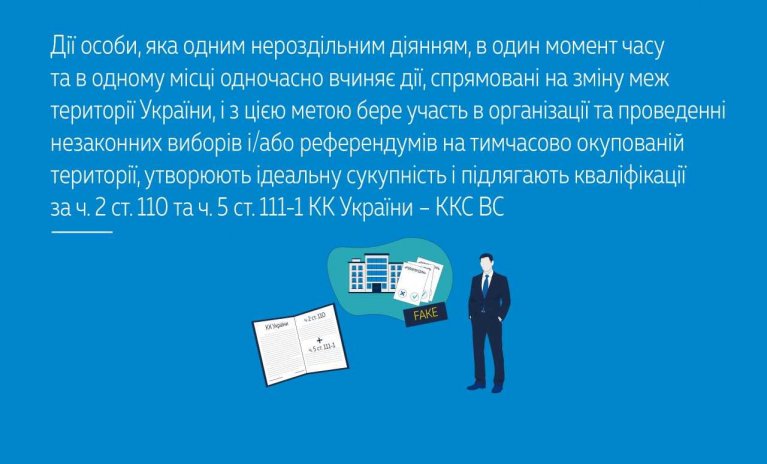
The actions of a person who, by one indivisible act, at the same moment in time and in the same place, simultaneously commits actions aimed at changing the borders of Ukraine’s territory and, for this purpose, participates in the organization and conduct of illegal elections and/or referendums on temporarily occupied territory, constitute an ideal concurrence of offences and are subject to qualification under Part 2 of Article 110 and Part 5 of Article 111-1 of the Criminal Code of Ukraine.
In this criminal proceeding, the person was accused of participating in the organization and conduct of an illegal referendum on the issue of joining the Russian Federation as an administrative-territorial unit of the temporarily occupied territory of Luhansk region, with the aim of changing the borders of Ukraine’s territory and state border. The local court found the accused guilty under Part 5 of Article 111-1 of the Criminal Code of Ukraine and acquitted him under Part 2 of Article 110 of the Criminal Code of Ukraine. The appellate court found the accused guilty under Part 2 of Article 110 and Part 5 of Article 111-1 of the Criminal Code of Ukraine.
In the cassation appeal, the defence counsel argued that qualifying the accused’s actions under both Part 5 of Article 111-1 and Part 2 of Article 110 of the Criminal Code of Ukraine constituted double qualification, since the referendum, the degree of participation, and the scope of actions were the same. Moreover, one of the actions aimed at changing the borders of the territory or state border is participation in the preparation and conduct of an illegal referendum. This, taken together, contradicts the requirements of Article 61 of the Constitution of Ukraine and Part 3 of Article 2 of the Criminal Code of Ukraine. Therefore, the actions of the accused do not contain the elements of the offence under Part 2 of Article 110 of the Criminal Code of Ukraine.
Upholding the appellate court’s verdict, the Supreme Court stated that to distinguish between these offences it is necessary to refer to such a qualifying feature as the purpose. Thus, the purpose of the crime under Part 2 of Article 110 of the Criminal Code of Ukraine, in view of the disposition of that part of the article, is clear and consists in the seizure of part of Ukraine’s territory, its annexation to the aggressor state, or the creation of new entities, etc., i.e., it encroaches on the territorial integrity and inviolability of Ukraine, regardless of the specific actions taken to achieve this purpose. Liability under Part 2 of Article 110 arises when a person’s actions are directed at changing the borders of Ukraine’s territory or its state border.
At the same time, the purpose of the crime under Part 5 of Article 111-1 of the Criminal Code of Ukraine is not obvious and, given the exclusively direct intent, is aimed at assisting (aiding and abetting, supporting) the aggressor state, its bodies or representatives in carrying out their activities. Liability for this is provided, in particular, specifically for actions in the form of participation in the organization and conduct of illegal elections and/or referendums on temporarily occupied territory.
However, if a person, by a single act, simultaneously commits two or more independent criminal offences, and all the offences are committed at the same time by one indivisible act, at the same moment in time and in the same place (the same actions), then, if the relevant elements are present, they are qualified under different articles or parts of articles of the Criminal Code of Ukraine and constitute an ideal concurrence of offences. Therefore, taking into account the different directions of the accused’s intent while performing the same actions, at the same moment in time and in the same place, the appellate court correctly concluded that there was an ideal concurrence of criminal offences in this proceeding.
Resolution of the Criminal Cassation Court of the Supreme Court dated December 8, 2025, in case No. 185/7229/23 (proceedings No. 51-3301km25) – https://reyestr.court.gov.ua/Review/132590454.
This and other legal positions of the Supreme Court can be found in the Database of Legal Positions of the Supreme Court - https://lpd.court.gov.ua.
_03_03.png)