Contact center of the Ukrainian Judiciary 044 207-35-46
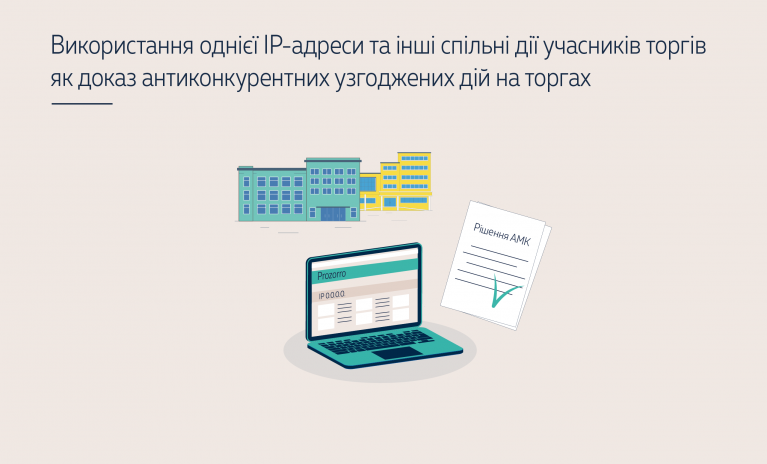
Anticompetitive concerted actions by tender participants are confirmed by a combination of the following indirect evidence: the use of a single IP address, synchronised actions when submitting bids, the absence of competitive behaviour, the existence of employment links between related parties, and the exchange of information. These circumstances indicate distortion of the tender results and the absence of genuine competition.
This conclusion was reached by a panel of judges of the Commercial Cassation Court within the Supreme Court.
LLC-1 filed a lawsuit against the Antimonopoly Committee of Ukraine (AMCU) and a third party that does not assert independent claims regarding the subject of the dispute (on the plaintiff’s side – LLC-2) seeking to declare invalid and cancel the decision of the Temporary Administrative Board of the AMCU “On Violation of Legislation on Protection of Economic Competition and Imposition of a Fine”. By this decision, LLC-1 was found to have committed an offence under Clause 1 of Article 50 and Clause 4 of Part 2 of Article 6 of the Law of Ukraine “On Protection of Economic Competition”, in the form of anticompetitive concerted actions aimed at distorting the results of tenders by coordinating behaviour during the preparation of tender proposals and participation in procurement procedures.
The commercial court dismissed the claim, and the appellate commercial court upheld this decision. The Commercial Cassation Court of the Supreme Court left the decisions of the previous instances unchanged.
According to the AMCU’s decision, LLC-1 engaged in concerted actions with other tender participants aimed at falsifying the results of an auction in the Prozorro system. The AMCU’s decision is based on a combination of indirect evidence, including: use of the same IP address by two tender participants, confirming their joint activity; synchronicity of actions in submitting tender proposals and paying for services on electronic platforms; LLC-1 uploading documents containing data on LLC-2’s employees; identical characteristics of the uploaded electronic files, indicating a single source of preparation; stable connections between the participants, including common counterparties and financial assistance between the companies before the tenders were announced.
The Commercial Cassation Court of the Supreme Court confirmed that the courts of previous instances correctly assessed the evidence, in particular the existence of proof of concerted behaviour, and stated that proving a violation based on a combination of circumstances is sufficient to qualify the actions as anticompetitive concerted actions. The Supreme Court also noted that to establish the offence, it is sufficient to prove the existence of concerted actions that lead or may lead to distortion of tender results, without the need to prove negative consequences or the fault of the participants.
The Commercial Cassation Court of the Supreme Court found the AMCU’s conclusions regarding the violation of competition protection legislation to be lawful. The AMCU’s decision is well-reasoned and sufficiently motivated, and the established facts and circumstances indicate concerted behaviour by the tender participants.
Resolution of the Commercial Cassation Court of the Supreme Court dated November 13, 2025, in case No. 910/102/25 – https://reyestr.court.gov.ua/Review/131821229.
This and other legal positions of the Supreme Court can be found in the Database of Legal Positions of the Supreme Court - https://lpd.court.gov.ua.
_03_03.png)