Contact center of the Ukrainian Judiciary 044 207-35-46

With the onset of the full-scale war, the issue of countering corruption has not only remained relevant but has acquired new meaning. Today, corruption-related criminal offences can, without exaggeration, be equated to crimes against the foundations of national security in terms of their level of public danger, as they undermine the authority of the state as a whole.
This was stated by the President of the Supreme Court, Stanislav Kravchenko, during the presentation of the analytical report “Corruption Risks in the Justice Sector”, organized by the National Agency on Corruption Prevention (NACP) jointly with the OSCE.
In the opinion of the President of the Supreme Court, merely declaring zero tolerance for corruption is not effective in itself. What is crucial is a deep analysis of the causes and preconditions of this phenomenon, a systematic study of the areas of activity of state bodies where it manifests or potentially may manifest, as well as an assessment of the consequences it may lead to.
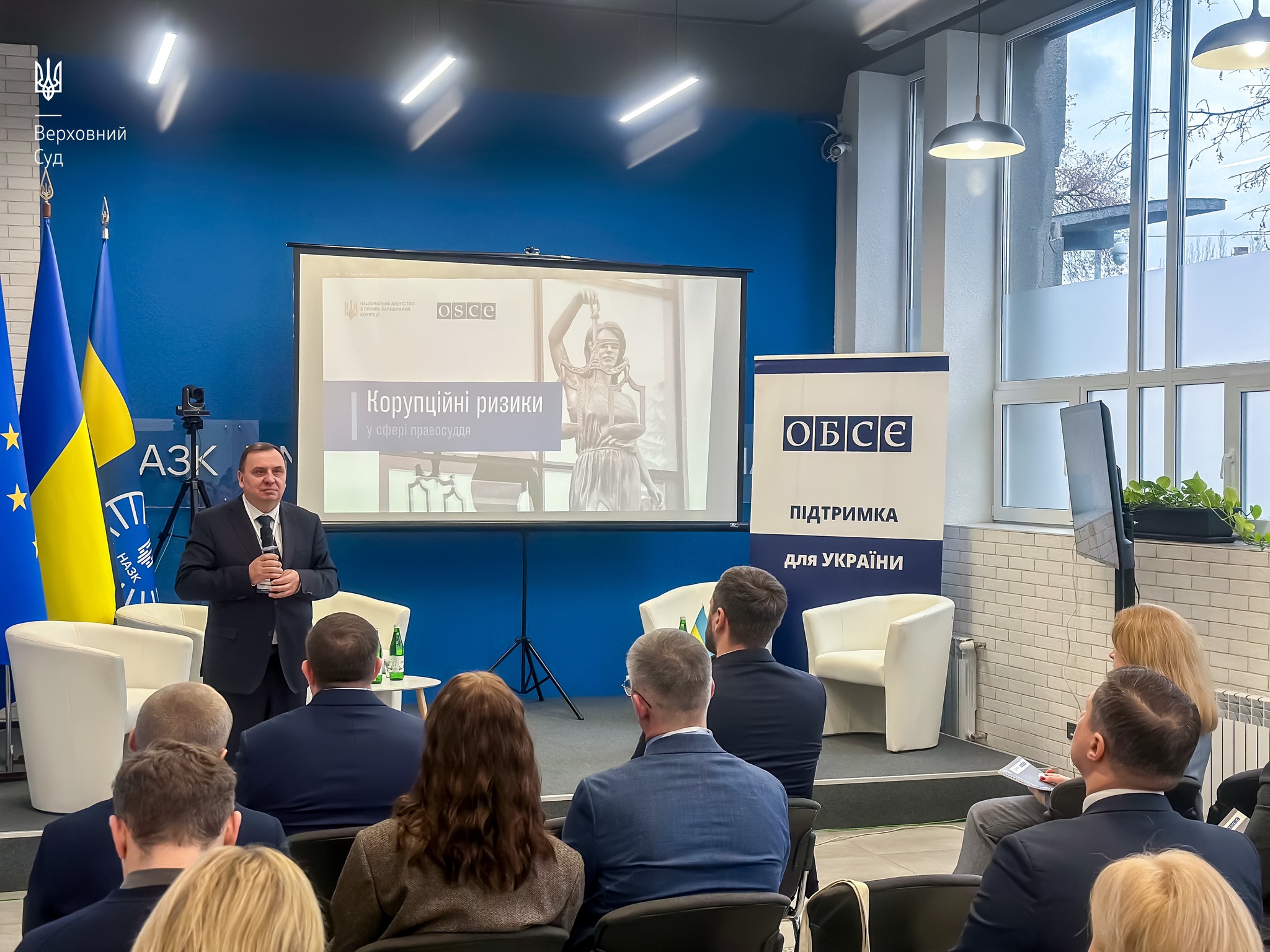
At the same time, taking into account international experience and the development of anti-corruption mechanisms in Ukraine, there is an obvious need for clear rules and effective instruments to prevent corruption, as well as for the proper functioning of the relevant specialized state authorities. Only under such conditions can one expect a clear positive result and minimize the threats posed by corruption.
As part of the study, the NACP, together with experts from the OSCE project “Support to the Development of Effective Instruments for Preventing Corruption and Strengthening Anti-Corruption Compliance in Ukraine”, identified the most significant corruption risks in the justice sector. In particular, these risks are associated with the procedures for the selection, qualification assessment, and disciplinary liability of judges, their secondment and election to administrative positions, the resolution of issues related to conflicts of interest and recusal, as well as the financial support of courts.

The analytical report also contains recommendations for minimizing or eliminating the identified risks.
According to Stanislav Kravchenko, these developments have significant practical value, as they can be used to strengthen the anti-corruption component in other problematic areas and are potentially likely to be reflected in judicial practice.
_03_03.png)