Contact center of the Ukrainian Judiciary 044 207-35-46
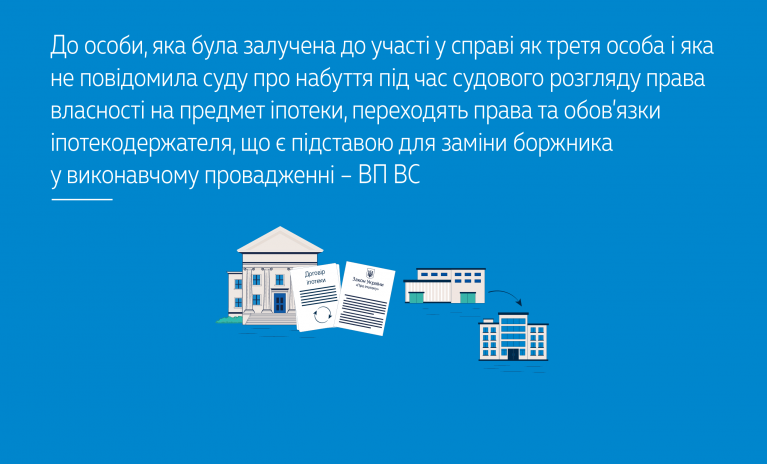
Rights and obligations of the mortgagee pass to a person who was involved in the case as a third party without independent claims and who did not notify the court of acquiring rights to the subject matter of the dispute during the court proceedings. This serves as grounds for replacing the debtor with that person in enforcement proceedings.
This conclusion was reached by the Grand Chamber of the Supreme Court.
According to the circumstances of the case, a bank filed a lawsuit against the mortgagor seeking foreclosure on the mortgaged property to repay the borrower’s debt under loan agreements. The commercial court opened proceedings in the case and involved another enterprise as a third party without independent claims on the side of the defendant. The court of appeal, by a ruling upheld by the cassation court, granted the claim.
The financial company, as the legal successor of the bank, having discovered that the defendant had alienated the mortgaged property during the merits stage of the case and that ownership had subsequently passed to the enterprise involved in the case as a third party, applied to the court with a motion to replace the defendant with its legal successor.
The court of appeal granted the motion and replaced the defendant with its legal successor – the enterprise. However, the latter filed a cassation appeal, asserting that the rights and obligations of the debtor in enforcement proceedings had not passed to it, in particular because the ruling of the court of appeal on foreclosure of the mortgaged property was adopted after the registration of ownership rights in its favour.
Following the review of the court decisions, the Grand Chamber of the Supreme Court noted that the Supreme Court has repeatedly emphasized that persons participating in a case have a general obligation to exercise their procedural rights and perform their procedural duties in good faith.
The enterprise, as a third party involved in the case without independent claims regarding the subject matter of the dispute, had all the opportunities provided by procedural law to declare its rights to the property that was the subject of the mortgage and on which the court was deciding foreclosure during the consideration of the case on the merits. Having acquired ownership of the mortgaged property that was the subject of the dispute in this case, the appellant did not notify the court that the decision in this case affects its rights and obligations. In particular, when appealing the decision on the merits, it did not indicate that the decision concerned property belonging to it.
As a result of failing to take the appropriate procedural steps, such a person faces the consequence that the court, when considering the application to replace the debtor with a legal successor, is no longer able to examine arguments related to the review of the court decisions on the merits.
Under such circumstances, the Grand Chamber of the Supreme Court concluded that, given the in rem nature of the claim for foreclosure under the conditions where the enterprise was involved as a third party that acquired rights to the subject matter during the court proceedings but did not notify the court that the decision on foreclosure would concern property belonging to it, the final decision on the merits of the case — that is, the ruling of the appellate commercial court, left unchanged by the ruling of the cassation court — is a decision on the rights and obligations of the enterprise. By the contested ruling on the replacement of the debtor, the court merely aligned the status of the enterprise in the enforcement proceedings with the status that had actually arisen in the case as a result of the court’s decision on the merits.
The Grand Chamber of the Supreme Court agreed with the court of appeal that there were grounds to conclude that, under Article 23 of the Law of Ukraine “On Mortgage”, along with the property encumbered by the mortgage, the rights and obligations of the mortgagee passed to the enterprise. Thus, a substitution occurred in the substantive legal relations, which constitutes grounds for replacing the debtor in the procedural relations.
Resolution of the Grand Chamber of the Supreme Court dated 3 December, 2025, in case No. 902/388/18 (proceedings No. 12-36гс25) – https://reyestr.court.gov.ua/Review/132391401.
This and other legal positions of the Supreme Court can be found in the Database of Legal Positions of the Supreme Court - https://lpd.court.gov.ua.
_03_03.png)