Contact center of the Ukrainian Judiciary 044 207-35-46
Since as early as 2014, and especially after 24 February 2022, Russia’s war against Ukraine has had a profoundly negative impact on the realisation of the right of access to court. The full-scale Russian invasion has confronted the judicial community with a range of challenges concerning the organisation of the administration of justice. Due to the occupation of certain territories by the aggressor, Ukraine is unable to ensure the functioning of courts or provide physical access to justice for citizens in those areas.
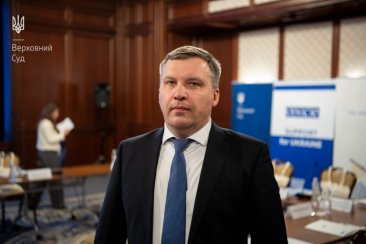
This was noted by the Secretary of the Grand Chamber of the Supreme Court Vitalii Urkevych during a webinar organised by the Ukrainian Hub of the European Law Institute (ELI), which operates on the basis of the Faculty of Law of the West Ukrainian National University. The event launches a series of webinars aimed at familiarising participants with the case law and practice of the Supreme Court.
In his presentation, Vitalii Urkevych focused on the specific features of the administration of justice in Ukraine under wartime conditions (change of territorial jurisdiction of cases, secondment of judges, operation of courts during air-raid alerts, digitalisation of court proceedings) and highlighted key legal positions adopted by the Supreme Court in cases related to the war.
According to him, one of the problematic issues has been determining the precise moment from which a particular territory can be considered occupied, in order to establish which legal regime applies to that territory. Thus, by Order No 376 of the Ministry for Communities and Territories Development of Ukraine dated 28 February 2025, a List of Territories on which Hostilities Are/Were Conducted or Which Are Temporarily Occupied by the Russian Federation was approved. More recently, the Joint Chamber of the Commercial Cassation Court within the Supreme Court, in its resolution of 3 October 2025 in case No 908/1162/23 concerning the possibility of carrying out economic activity in the city of Melitopol, concluded that the legal status of a temporarily occupied territory does not depend on the existence of a decision by a state authority recognising the territory as occupied. The prohibition on conducting economic activity in a temporarily occupied territory applies from the moment of the actual occupation, which is a generally known fact and does not require separate proof.
As of today, due to Russian armed aggression, 170 court buildings have been damaged and 19 court buildings have been destroyed, making it impossible to administer justice in them. One of the steps Ukraine took to ensure access to courts during martial law was to amend the Law of Ukraine “On the Judiciary and the Status of Judges” at the beginning of the full-scale invasion. These amendments provide that, where it is objectively impossible for a court to administer justice, the territorial jurisdiction of cases pending before that court may be changed by a decision of the High Council of Justice, adopted upon submission by the President of the Supreme Court, through transfer to another court. If the High Council of Justice is unable to exercise this power, it is exercised by order of the President of the Supreme Court. Thus, since the beginning of the full-scale invasion, the territorial jurisdiction of cases in 171 courts has been changed due to the impossibility of administering justice during martial law. The jurisdiction of 60 courts has been restored following the de-occupation of Ukrainian territories, while 96 courts remain in temporarily occupied territories.
Due to the impossibility of hearing cases in occupied territories, more than 420 judges have been seconded from courts whose territorial jurisdiction of cases was changed.
Difficulties also arise with access to case files. A large number of them are controlled by the aggressor state, and many case materials have been lost due to occupation or hostilities and cannot be fully restored. Moreover, the significant time required to restore case materials also affects the duration of proceedings.
In addition, Ukrainian courts are forced to adjourn hearings due to numerous air-raid alerts. In this context, Vitalii Urkevych drew attention to a conclusion of the Supreme Court, according to which holding a court hearing during an air-raid alert in the absence of the parties constitutes a violation of their right to participate in the proceedings and serves as grounds for setting aside the court decision (resolution of the Civil Cassation Court of the Supreme Court dated 26 February 2025 in case No 752/8937/24).
Another problem is the staffing shortage. Ukraine is short of approximately 2,200 judges across courts of all instances and jurisdictions. In courts of first instance, 1,324 positions remain vacant. There is also a significant shortage of court staff.
At the same time, the High Qualification Commission of Judges of Ukraine is actively working to address this issue. On 11 December 2024, the Commission launched a selection process to form a reserve of candidates for 1,800 positions of judges of first-instance courts. In parallel, competitions are being held for positions in appellate courts and the High Anti-Corruption Court. The High Qualification Commission of Judges has also announced a competition for positions in newly established courts: 17 in the Specialised District Administrative Court and 10 in the Specialised Appellate Administrative Court.
In extremely challenging wartime conditions, the development of electronic justice systems plays a leading role. The use of video-conferencing technologies significantly facilitates the organisation of court work amid security threats. As the Secretary of the Grand Chamber of the Supreme Court reported, there is a clear trend of annual growth in the number of court hearings conducted via video conference: 766,419 in 2022, 1,669,282 in 2023, and as many as 2,545,803 in 2024. Similarly, there has been a colossal increase in the number of applications to courts through the “Electronic Court” system (548,813 in 2022, 1,430,893 in 2023, and 3,186,546 in 2024).
Overall, in 2024, 4,422,806 cases and materials were received by local and appellate courts of Ukraine. Of these, nearly 4.3 million were considered. The Supreme Court received over 90,000 cassation appeals in 2024, of which approximately 87,500 were examined, representing 96.4%. In Vitalii Urkevych’s view, these statistics on appeals to Ukrainian courts demonstrate that, despite the war, citizens and business entities continue to trust the courts and seek protection through them.
The speaker also presented key legal conclusions adopted by the Grand Chamber of the Supreme Court in cases related to the war. In particular, Vitalii Urkevych highlighted the following legal positions:
Separately, Vitalii Urkevych highlighted a recent important conclusion of the Grand Chamber of the Supreme Court regarding the court’s obligation to stay proceedings in a case where a party or a third party asserting independent claims concerning the subject matter of the dispute is serving in the Armed Forces of Ukraine or other military formations established in accordance with the law, which have been placed on a wartime footing or involved in conducting an anti-terrorist operation, as provided for in point 2 of part 1 of Article 251 of the Civil Procedure Code of Ukraine. In its resolution dated 12 November 2025 in case No 754/947/22, the Grand Chamber of the Supreme Court held that, from the moment martial law was introduced in Ukraine and until its cancellation or termination, the Armed Forces of Ukraine and other military formations established in accordance with the law must be regarded as having been “placed on a wartime footing”. Furthermore, when deciding whether to stay proceedings in a case due to a party or a third party asserting independent claims being a member of the Armed Forces of Ukraine, the court must take into account the expressed will of the serviceman himself.
For more details, see Vitalii Urkevych’s presentation: https://court.gov.ua/storage/portal/supreme/prezentacii_2025/Prezent_Pravocyd_war_prav_vusn.pdf
_03_03.png)