Contact center of the Ukrainian Judiciary 044 207-35-46
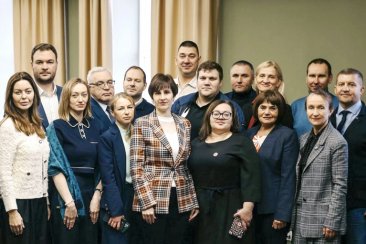
Criminal offences in the sphere of official activities represent one of the most complex categories of cases. Therefore, it is important to clearly identify the key controversial issues in this area and determine which of them have already been addressed by the conclusions of the Supreme Court. This was noted by the Vice President of the Criminal Cassation Court within the Supreme Court, Nataliia Antoniuk, during a training session for trainers on the topic “Criminal Offences in the Sphere of Official Activities and Professional Activities Related to the Provision of Public Services” for judges and judicial assistants of local general and appellate courts.
According to Nataliia Antoniuk, in criminal proceedings concerning corruption crimes, the most frequent issues are the delimitation of the elements of different offences and the admissibility of evidence.
The Supreme Court has already formed conclusions on a number of controversial issues, such as: criminal liability of persons who made decisions as members of a collegial body; qualification of the actions of an intermediary in the transfer of undue advantage; the possibility of holding an accomplice liable before the principal perpetrator; as well as the elements of the offence provided for in Article 364 of the Criminal Code of Ukraine, among others.
In the context of substantive law, the judge drew attention to the qualification of the actions of members of a collegial body for receiving undue advantage. In its resolution of April 23, 2024, in case No. 726/776/17, the Criminal Cassation Court of the Supreme Court concluded that the actions of a person who is a member of a collegial body may be qualified under Article 368 of the Criminal Code of Ukraine even when the issue for which the undue advantage was transferred was decided by a joint decision of the collegial body based on the results of voting. Moreover, it does not matter what decision was made by such a collegial body (positive or negative for the provider of the undue advantage).
The Supreme Court also considered the qualification of the actions of an intermediary in cases involving the receipt of undue advantage. Thus, the Criminal Cassation Court indicated that a person who transfers an undue advantage, as well as an intermediary in such transfer, do not necessarily have to be aware of the exact details of the ultimate recipient of such undue advantage, the distribution of the undue advantage among several persons, or the precise roles to be performed by the recipients of the undue advantage. For the qualification of the acts under Article 369 of the Criminal Code of Ukraine, it is sufficient to be aware that an undue advantage is being transferred (resolution of February 25, 2025, in case No. 127/18888/20).
In the resolution of May 6, 2025, in case No. 991/1324/20, the Criminal Cassation Court of the Supreme Court resolved the issue of the possibility of finding a convicted person guilty of complicity without the simultaneous or prior finding of guilt of the principal perpetrator of the crime. Thus, although the liability of an accomplice is derivative from the liability of the principal perpetrator, this does not indicate the impossibility of holding the accomplice liable in separate proceedings.
Nataliia Antoniuk also recalled two conclusions of the Joint Chamber of the Criminal Cassation Court of the Supreme Court concerning Article 364 of the Criminal Code of Ukraine (“Abuse of Power or Official Position”).

In the first of them (resolution of the Joint Chamber of the CrimCC of the Supreme Court dated November 27, 2023, in case No. 991/3966/20), the actions of a People’s Deputy in receiving compensation for housing expenses were qualified precisely as abuse of power, since he unlawfully used guarantees directly related to the performance of his functions as a representative of the state authority.
The other case (resolution of the Joint Chamber of the CrimCC of the Supreme Court dated February 10, 2025, in case No. 757/11969/18-к) concerned proving the existence of relations between the person abusing power or official position and third parties in whose interests such abuse occurs. It was established therein that the fact of the presence or absence of certain agreements or contact connections between an official and another person who received an undue advantage has no criminal-legal significance for the qualification of the official’s actions under the relevant part of Article 364 of the Criminal Code of Ukraine.
In the resolution of May 21, 2024, in case No. 686/8627/22, the Criminal Cassation Court of the Supreme Court stated that members of a medical-social expert commission (MSEC) make decisions on behalf of such a commission; therefore, when adopting legally significant decisions of the commission, they are persons authorized to perform the functions of the state within the meaning of the note to Article 369-2 of the Criminal Code of Ukraine.
In the aspect of procedural law, Nataliia Antoniuk drew attention to the conclusions of the Supreme Court, in particular regarding the specifics of conducting searches. Thus, the resolution of March 28, 2024, in case No. 397/430/20 concerned the conduct of a search of a vehicle in an urgent case related to the preservation of property, including the received undue advantage. The urgency of conducting the vehicle search was due to objective reasons, as it was impossible to predict in advance the further actions of the person after receiving the undue advantage. Many issues regarding urgent searches were also analyzed in the resolution of the CrimCC of the Supreme Court dated August 12, 2025, in case No. 991/1710/22.
The speaker also focused on the criteria for determining the presence or absence of signs of crime provocation, using the example of the resolution of the Criminal Cassation Court of the Supreme Court dated March 28, 2023, in case No. 391/729/15-к. As concluded by the Supreme Court, provocation of a crime may be present when law enforcement agencies artificially created a situation to induce a person to commit an offence. However, if law enforcement agencies merely joined in the recording and investigation of the crime, this indicates their passive role, which manifested only in the proper documentation of the committed criminal offence.
In addition, Nataliia Antoniuk discussed the following procedural aspects in cases involving official crimes:
The training was organized by the National School of Judges of Ukraine with the support of the European Union Advisory Mission in Ukraine.
_03_03.png)