Contact center of the Ukrainian Judiciary 044 207-35-46
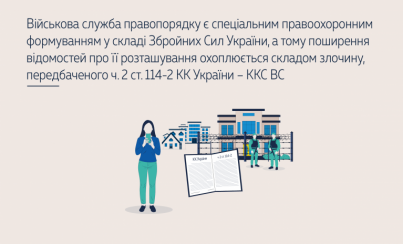
In this criminal proceeding, the courts of previous instances found the defendant guilty and convicted her under Part 2 of Article 114-2 of the Criminal Code of Ukraine for video-recording the location of a Military Law Enforcement Service unit (MLES unit), verbally describing and pointing out the site's location, and posting this video on her personal YouTube channel (with 12,700 subscribers) as well as on the social network TikTok. In her cassation appeal, the defense argued that a MLES unit is a law enforcement body specializing in maintaining internal order, its personnel do not participate in combat operations, and thus it is not a military formation. Therefore, the defendant's actions do not constitute the elements of the criminal offense under Part 2 of Article 114-2 of the Criminal Code of Ukraine.
Upholding the decisions of the lower courts without change, the Supreme Court noted that a letter from the Main Directorate of the Military Law Enforcement Service of the Armed Forces of Ukraine confirms that, pursuant to the Law of Ukraine “On the Military Law Enforcement Service in the Armed Forces of Ukraine”, the Military Law Enforcement Service of the Armed Forces of Ukraine is a special law enforcement formation within the Armed Forces of Ukraine. Information about the location of a MLES unit is not subject to public disclosure and has not been published on the official web portals of the Ministry of Defence of Ukraine or the General Staff of the Armed Forces of Ukraine. Accordingly, the defenсe's assertion that the location of the MLES unit is common knowledge contradicts the evidence obtained in the case, as open sources – including at the address where the defendant recorded the video with reference to the terrain – contain no data whatsoever about the location of the relevant military formation.
The panel of judges of the Criminal Cassation Court of the Supreme Court emphasized that the very act of video-recording the location of a military facility, documenting the presence of military personnel or equipment in or near it – i.e., confirming that such a facility is functioning in its regular mode – may create a threat to that facility through the subsequent dissemination of the relevant information, regardless of the method used (publication in the press, transmission via radio or television, use of other mass media, through the Internet, social networks, or other means of telecommunication).
Resolution of the panel of judges of the Third Judicial Chamber of the Criminal Cassation Court of the Supreme Court dated 23 October 2025 in case No. 725/4553/24 (proceedings No. 51-2677км25) — https://reyestr.court.gov.ua/Review/131394151.
This and other legal positions of the Supreme Court can be found in the Database of Legal Positions of the Supreme Court - https://lpd.court.gov.ua.
_03_03.png)