Contact center of the Ukrainian Judiciary 044 207-35-46

When we talk about protecting the rights of servicemembers, we are essentially talking about Ukraine’s ability to function as a democratic state governed by the rule of law, even during wartime.
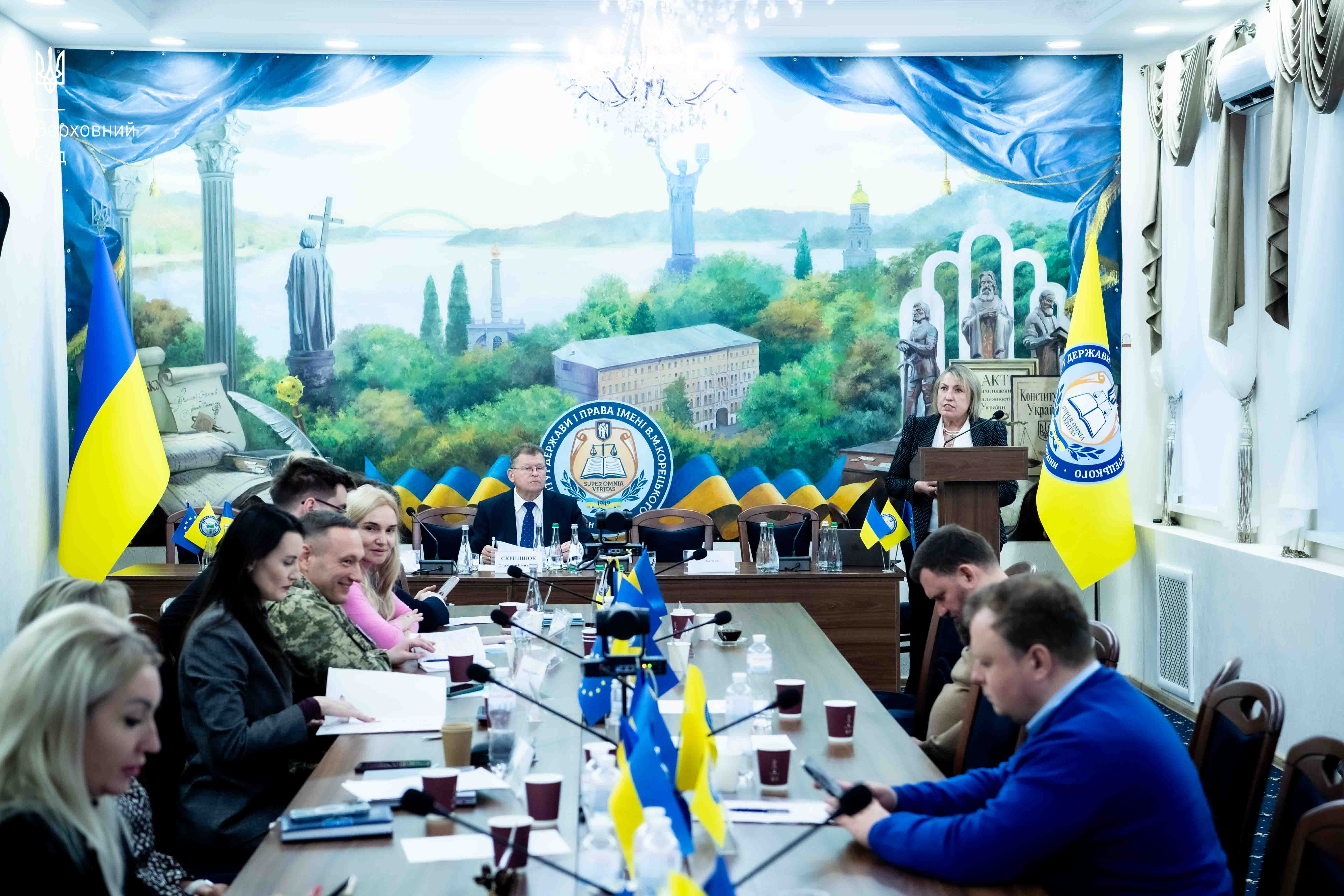
President of the Supreme Court Stanislav Kravchenko emphasized this during an expert discussion titled “Protection of Servicemembers’ Rights: Science and Practice – Synergy and Interdisciplinarity”, organized by the V. M. Koretsky Institute of State and Law of the National Academy of Sciences of Ukraine.
According to the President of the Supreme Court, since the beginning of the full-scale war, Ukraine’s judicial system has found itself in a reality where fulfilling its constitutional functions has required additional attention and significantly greater effort. This concerns not only security challenges but also new categories of cases coming before the courts.
As of the end of October 2025, more than 40,000 cases and materials were pending before the Administrative Cassation Court within the SC. Over 6,000 of them relate to issues connected with mobilization, military service, and the social protection of veterans.
%20(1).jpg)
In addition, commercial courts are currently considering disputes regarding the execution of defence procurement contracts; civil courts are dealing with applications to establish facts related to being in a combat zone, missing persons, and inheritance matters; and in the criminal jurisdiction, proceedings are being conducted concerning offences against military service regulations.
Thus, today the Supreme Court is not only an arbiter but also a mechanism for stabilizing the legal system during wartime. Its case law shapes legal guidelines that allow for balancing military necessity with human rights.
Stanislav Kravchenko also noted that this year, two draft laws providing for the establishment of military courts were registered in Parliament. When the Plenum of the Supreme Court considered whether to approve conclusions on these draft laws, it became evident that there are differing - and in some cases completely opposing - views on whether such courts are needed at all, what categories of cases they should hear, and how their jurisdiction should be delineated from that of administrative, commercial, and general courts.
In light of this, a working group was created within the Supreme Court to examine these draft laws. Its goal is to formulate a unified vision for resolving this issue, taking into account the views of the academic community and servicemembers.
This event is one of the platforms for discussing problems and finding solutions - a place where judges, scholars, civil society, and lawmakers act as a single system in the interests of servicemembers, their families, and ultimately the entire state.
%20(2).jpg)
The first session was moderated by Judge of the Grand Chamber of the Supreme Court Oleh Tkachuk, who outlined the key idea of the meeting: the protection of servicemembers’ rights is impossible without an effective mechanism for implementing Article 55 of the Constitution of Ukraine. He emphasized that millions of servicemembers and war veterans require real, not merely declarative, access to justice. In this context, the judge stressed the importance of restoring and developing institutions of military justice, in particular as a component of state policy aimed at enhancing the prestige of military service and ensuring effective judicial protection.
The moderator highlighted the historical roots of Ukrainian military jurisdiction, reminding the audience that military law and military courts have always been part of the institutional development of the state. The modern challenges of war have once again underscored the need for specialized mechanisms for resolving disputes related to military service, disciplinary issues, social guarantees, and also the liability of servicemembers. For this reason, the dialogue between academia, judicial practice, and the legislature, initiated by the V. M. Koretsky Institute of State and Law of the National Academy of Sciences of Ukraine, is extremely important for forming a coherent concept of military law.
%20(1).jpg)
During the first session of the expert discussion, Judge of the Grand Chamber of the Supreme Court Olena Hubska delivered a presentation in which she focused on the practical problems of handling disputes involving servicemembers in administrative, civil, and criminal jurisdictions. She concentrated on three main categories of such cases: those concerning military service, dismissal, and social security. Numerous disputes also concern the payment of additional remuneration in the amounts of 30,000 and 100,000 UAH. The judge noted that due to the difficulties of maintaining records in combat conditions, servicemembers often find themselves in a situation where the necessary data to confirm participation in hostilities is unavailable. In such cases, courts face the particularly demanding task of ensuring a balance between formal requirements and the actual circumstances of service.
Special attention was devoted to issues of social payments, including holiday allowances. The judge reminded that courts are guided by constitutional provisions allowing for certain restrictions during martial law, which affects payment procedures. At the same time, such restrictions must be applied proportionately and with consideration of the real needs of servicemembers. Concluding her remarks, Olena Hubska emphasized the importance of professional discussion regarding the draft laws on military courts, as the various models of specialized jurisdiction functioning around the world demonstrate different approaches, and the Ukrainian system must choose the model that is optimal given its own circumstances.
%20(1).jpg)
During the second session, Judge of the Grand Chamber of the Supreme Court Nadiia Stefaniv addressed the issue of criminal offences committed by servicemembers and the specific features of judicial proceedings in such cases. She presented consolidated conclusions regarding the scale of this category of cases. The register of court decisions contains tens of thousands of verdicts for military offences, and the number of pending proceedings is even greater.
The judge emphasized that the complexity of these cases requires specialized knowledge and training on the part of investigators, defence attorneys, and judges. The issue of qualifying offences is particularly acute, as the line between unauthorized abandonment of a military unit and desertion is very thin and depends on a careful analysis of the evidence.
Another important topic concerned sentencing during martial law, when the legislature significantly strengthened sanctions for a number of types of military criminal offences. The speaker cited cases where the application of special provisions allowing release from criminal liability upon a submission by a unit commander made it possible for servicemembers to return to duty. In her view, this demonstrates the need for more flexible response mechanisms aimed at protecting the rights of servicemembers while ensuring military discipline.
The judge also noted that the establishment of specialized military courts is a logical step in the development of the military justice system. Such courts could not only enhance the professionalism of criminal proceedings related to military offences but also ensure the adjudication of war crimes, which under current conditions require a high level of expertise. This would help relieve the courts of general jurisdiction and create a stable, specialized system capable of responding comprehensively to the legal challenges of the war.
_03_03.png)