Contact center of the Ukrainian Judiciary 044 207-35-46
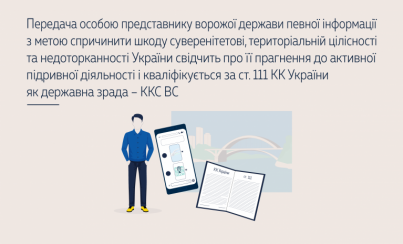
In this criminal proceeding, the courts of previous instances found the accused guilty and convicted him under Part 2 of Article 111 of the Criminal Code of Ukraine. Specifically, he transmitted information to a representative of a hostile state via the Viber messenger, including videos of trenches and checkpoints; photographs and coordinates of certain kindergartens and schools, as well as the river port; videos and coordinates of military unit warehouses, a territorial recruitment and social support centre, the Main Directorate of the National Police, the Officers’ House, the territorial defence headquarters, a correctional colony where military personnel were held, the commercial court, the regional prosecutor’s office, and the Security Service of Ukraine (SBU) regional directorate. In the cassation appeal, the defence argued that certain acts committed by the accused fell within the scope of Part 3 of Article 114-2 of the Criminal Code of Ukraine, under which no charges had been brought against him.
Upholding the decisions of the lower courts, the Supreme Court stated that the elements of the offences provided for in Part 2 of Article 111 and Part 3 of Article 114-2 of the Criminal Code of Ukraine share common features. Both “crossing over to the enemy’s side during an armed conflict” and “providing assistance to a foreign state, foreign organisation or their representatives in carrying out subversive activities against Ukraine” may, among other things, consist in the transmission of information referred to in Article 114-2 of the Criminal Code of Ukraine. Where the criminal act (actus reus) consists of transmitting information to representatives of a hostile state, Article 111 of the Criminal Code of Ukraine should be applied where, in addition to the common elements inherent in both offences, the conduct contains features that are decisive for the application of Article 111. The need for such additional features is also indicated by the proviso in Part 3 of Article 114-2 – “in the absence of signs of state treason or espionage”.
The distinction between Articles 114-2 and 111 of the Criminal Code of Ukraine, in cases involving the transmission of information referred to in Article 114-2, lies in the nature of the intent (mens rea) with which the incriminated acts are committed. In the commission of state treason, the transmission of certain information is directed towards achieving the objective of causing harm to the sovereignty, territorial integrity and inviolability, defence capability, state, economic or information security of Ukraine. Such a purpose goes beyond the mens rea of the offence under Article 114-2 and forms the intent characteristic of state treason.
As is apparent from the case file, the accused’s activities were of a systematic nature and were not limited to a one-off transmission of information; they were carried out on the instructions of a representative of the hostile state. Furthermore, according to the accused’s own admission, he transmitted certain information on his own initiative and also requested that he be provided with weapons so that, if the opportunity arose, he could provide effective support to the armed forces of the hostile state. The panel of judges of the Criminal Cassation Court of the Supreme Court held that these facts were sufficient to conclude that the accused’s intent went far beyond the mere one-off transmission of information to a representative of a hostile state. It demonstrated his conscious identification of his own goals with those of the hostile state and his aspiration to engage in active subversive activity. This permits the qualification of his conduct as state treason under Part 2 of Article 111 of the Criminal Code of Ukraine and does not require qualification under Part 3 of Article 114-2.
Resolution of the Criminal Cassation Court of the Supreme Court dated 14 October 2025 in case No 711/4047/22 (proceedings No 51-3940км22) – https://reyestr.court.gov.ua/Review/131320122.
This and other legal positions of the Supreme Court can be found in the Database of Legal Positions - https://lpd.court.gov.ua.
_03_03.png)