Contact center of the Ukrainian Judiciary 044 207-35-46

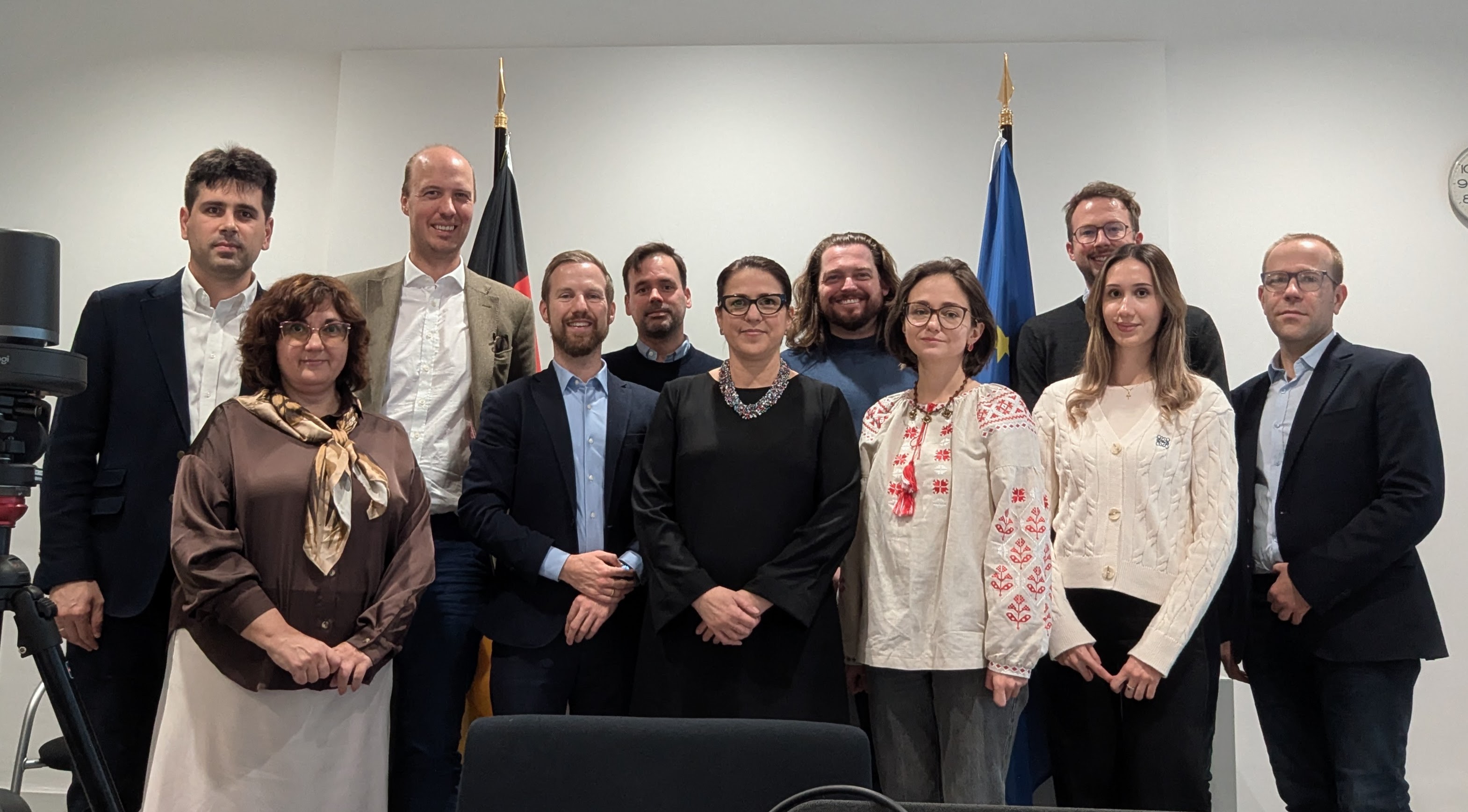
In October this year, Berlin (Federal Republic of Germany) hosted the second scientific and practical seminar held within the Ukrainian-German research project “E-Justice in Focus: A Comparative Study of Germany and Ukraine”, jointly implemented by the Faculty of Law of the National University of Kyiv-Mohyla Academy and the TH Köln – University of Applied Sciences. Representatives of the Ukrainian delegation took part in the seminar: Judge of the Supreme Court at the Commercial Cassation Court Olena Kibenko; Judge of the SC at the Criminal Cassation Court Oleksandra Yanovska; and First Deputy Chief of Staff – Head of the Department for Analytical and Legal Work of the SC, Rasim Babanly, who joined the event online.
The seminar was held at the BSP Business & Law School (Berlin) and brought together members of the judiciary, academics, and experts on digital justice. On the German side, participants included Professor Simon Johannes Heetkamp (TH Köln), Professor Christian Piroutek (Stralsund University of Applied Sciences), Professor Daniel Effer-Uhe, Founding Dean of the Faculty of Law at BSP Business & Law School, Hamburg Administrative Court Judge David Stadermann, Professor Sven Thorsten Peter Gelbke (TH Köln), student assistant Yulia Bubarev (TH Köln), Head of Public Policy at the Legal Tech Verband Deutschland Annika Schröder, and Noxtua’s Vice President for Legal Data, Clemens Hufeld.
During the seminar, participants discussed successful cases, legislative challenges, and systemic aspects of implementing e-justice in Ukraine and Germany. Particular attention was paid to the prospects, advantages, and risks of using artificial intelligence in the justice sector. The programme also included thematic meetings at the Federal Ministry of Justice and Consumer Protection of Germany (BMJV) and the Bundesrat.
.jpg)
Olena Kibenko delivered a presentation titled “The Use of Digital Tools in Judicial Work”. She described the case-management software used by the Supreme Court, the functionality of the Electronic Court subsystem, which enables document exchange, notifications to parties, and video-conference hearings. The judge also provided an overview of search and analytical programs used for legal analysis and highlighted the possibilities and limitations of applying AI tools in judicial work, noting that they may be appropriate for preparing presentations, reports, or translations but should not be used when working on cases or conducting legal research and analysis.
.jpg)
Oleksandra Yanovska delivered a presentation titled "Strategic and Tactical Issues of Evidence in the Context of the Digitalisation of Judicial Proceedings". She focused on the key challenges faced by judicial institutions amid the digital transformation of the justice sector. Among the main risks, the judge highlighted the potential for manipulation of digital data, the use of deepfakes, the falsification of metadata, and algorithmic bias, emphasising that the protection of confidentiality must remain a central principle when introducing digital technologies into judicial proceedings.
The speaker underlined the importance of developing unified practical standards for working with electronic evidence. These include ensuring the integrity of digital data through hashing and secure storage logs, meticulous documentation of every step of data processing with details of the tools and methods used, respecting the limits of expert competence, and verifying digital evidence by comparing it with traditional forms of proof. In Oleksandra Yanovska’s view, only strict adherence to these standards can ensure an appropriate level of evidential value for digital information in court.
The judge also outlined the need for legal reforms aimed at regulating the procedural status of digital evidence, establishing requirements for its authenticity, and creating transparent mechanisms for monitoring its use in judicial procedures. Concluding her presentation, Oleksandra Yanovska stressed: "Technology must serve justice, not replace it".
During the joint discussion, seminar participants also explored the issue of openness of judicial decisions and the differing approaches to publishing case law in Ukraine and Germany. It was noted that in Ukraine, 100% of judicial decisions are published, with data anonymisation conducted automatically, whereas in Germany only 1–5% are published, and anonymisation is carried out manually, placing personal responsibility on judges or lawyers. This approach has both advantages and risks: the openness of Ukrainian decisions supports the development of case law, academic analysis, and educational purposes, but may pose risks of disclosing personal data. At the same time, the British-American approach, which does not require depersonalisation of judicial decisions, was discussed as enabling more convenient citation of case law.
.jpg)
In his presentation, Rasim Babanly showcased the capabilities of the Supreme Court’s Database of Legal Positions and the updates introduced in 2025. He described the practical application of generative artificial intelligence in the functioning of the Database.
The speaker paid particular attention to the prospects for further integration of the Supreme Court’s Database of Legal Positions with the Electronic Court system, which is expected to create a unified digital environment for working with legal positions and procedural documents.
Participants also discussed issues of digital data security, transparency of judicial proceedings, and the potential for using artificial intelligence in the justice sector. The shared results and developments will form a basis for drafting practical recommendations aimed at improving legal regulation and addressing the contemporary challenges of the digitalisation of justice in Ukraine and EU member states.
_03_03.png)