Contact center of the Ukrainian Judiciary 044 207-35-46
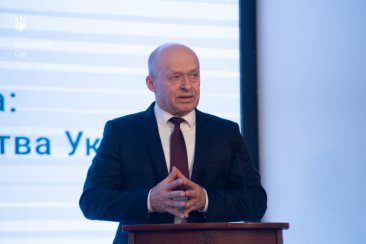
In the context of the transformation of public law relations and the growing role of the judiciary in affirming the rule of law and the supremacy of the Constitution of Ukraine, administrative courts occupy one of the central positions in the system for protecting constitutional rights and freedoms from violations by public authorities.
This was stated by Mykhailo Smokovych, President of the Administrative Cassation Court within the Supreme Court, during the opening of the International Seminar-Workshop “Determining the Constitutionality of a Law or Other Legal Act: Who is Competent under Article 7 of the Code of Administrative Procedure of Ukraine”, organized by the Administrative Cassation Court of the Supreme Court in cooperation with the Council of Europe, the German Foundation for International Legal Cooperation, and the EU Project “Pravo-Justice”.
The speaker noted that this year is a jubilee year for the administrative justice system of Ukraine - 6 July marks the 20th anniversary of the adoption of the Code of Administrative Procedure of Ukraine. For two decades, the Code has been established as a fundamental legal basis for the rule of law, a guarantor of transparency and accountability of the authorities, and an effective tool for protecting constitutional rights and freedoms in public law relations. Indeed, throughout these years, administrative justice has been the first to face the need to assess whether the actions of public authorities comply with the Basic Law of Ukraine, which requires judges to possess a high level of constitutional culture, methodological training, and a deep understanding of the principle of the direct effect of the Constitution of Ukraine.
The Head of the SC Administrative Cassation Court emphasized that the issue of determining the constitutionality of laws and other legal acts is directly linked to the fundamental principle of the supremacy of the Constitution of Ukraine. Within the system of public law, constitutionality serves as the criterion for the legality of decisions, actions, or inaction of public authorities. Article 7 of the Code of Administrative Procedure of Ukraine, he said, is of crucial importance for ensuring the rule of law in administrative proceedings, as it defines the limits of the court’s powers regarding the application of regulatory legal acts that contradict the Constitution of Ukraine.
Mykhailo Smokovych stressed that discussion of the issues raised at the workshop has not only practical but also doctrinal significance, as it concerns the relationship between the jurisdictional powers of administrative courts and the Constitutional Court of Ukraine, the formation of a culture of constitutionally oriented law enforcement, and the ensuring of the unity of judicial practice.
According to the Head of the SC Administrative Cassation Court, the European integration vector of administrative justice constitutes one of the key priorities in establishing Ukraine as a state governed by the rule of law. For the national judicial practice, it is important to study the experience of European states, in particular, in determining the constitutionality of laws and other regulations. The implementation of these European standards in domestic judicial practice will contribute to strengthening the democratic foundations of the functioning of state power, ensuring the rule of law, and advancing Ukraine’s strategic course toward European integration.
In concluding his welcoming remarks, Mykhailo Smokovych expressed his conviction that today’s professional dialogue, involving highly qualified experts, will promote deeper cooperation among representatives of the legal community, enhance the quality of legal reasoning in judicial decisions, and strengthen administrative justice as a guarantor of the rule of law and the supremacy of the Constitution of Ukraine in public law relations.
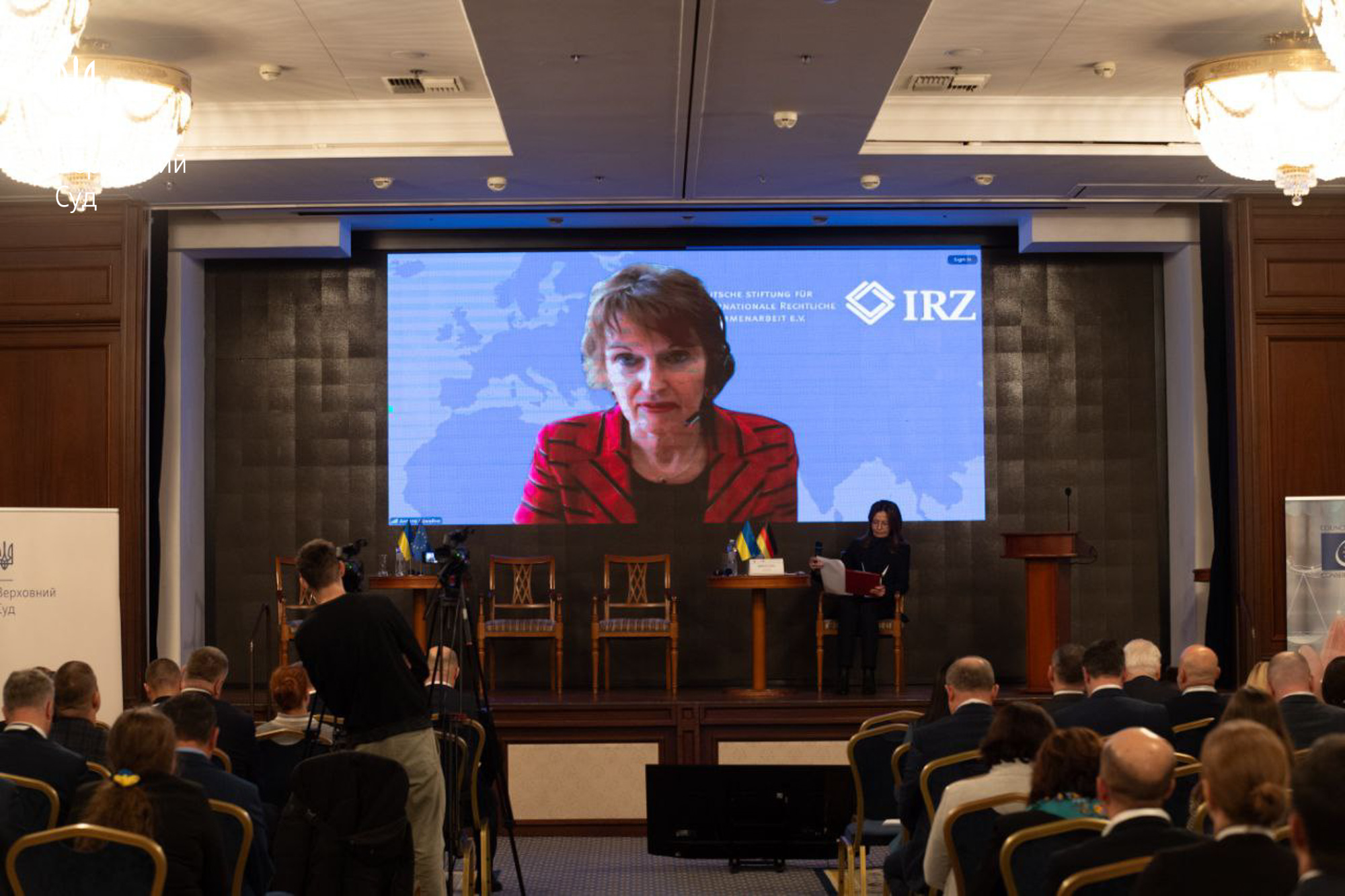
Welcoming the participants of the workshop, Angela Schmeink, Head of Projects for Ukraine and Vietnam at the German Foundation for International Legal Cooperation (IRZ), on behalf of the Foundation, expressed gratitude for Ukraine’s long-standing cooperation with IRZ on the path toward the successful establishment and further development of constitutional jurisdiction and administrative justice in Ukraine, as well as in the sphere of the influence of European law on national law enforcement.
According to her, one relevant example of such cooperation was a working visit of judges of the Constitutional Court of Ukraine and the Supreme Court to Germany and Austria, organized by IRZ and GIZ, which enabled Ukrainian judges to familiarize themselves with the specific features of German and Austrian judicial systems and to exchange experience with their European counterparts. Angela Schmeink also expressed her support for and respect toward the Ukrainian people, who are living under conditions that are difficult even to imagine and who demonstrate unprecedented resilience.

On behalf of the EU Project “Pravo-Justice”, the participants of the event were greeted by Virgilius Valančius, Senior International Expert, Support to EU Integration Process in the Justice Sector Component of EU Project “Pravo-Justice”. He emphasized that it is significant that the workshop brought together not only the professional legal community but also students, thus providing the younger generation with an opportunity to hear authoritative opinions - an aspect that is particularly important as Ukraine proceeds along the path of European integration.
As Virgilius Valančius recalled, this year the EU Project “Pravo-Justice”, together with judges of the Supreme Court at the Cassation Administrative Court, conducted a series of webinars and online workshops on the application of the Law of Ukraine “On Administrative Procedure”, which is fundamental to ensuring the rule of law. The flagship in this area is administrative justice itself, which provides effective oversight of public authorities. In the view of the international expert, this is especially important in light of European integration processes and the implementation of roadmaps in three key areas - the rule of law, public administration reform, and the functioning of democratic institutions - approved by the Cabinet of Ministers of Ukraine in May 2025.
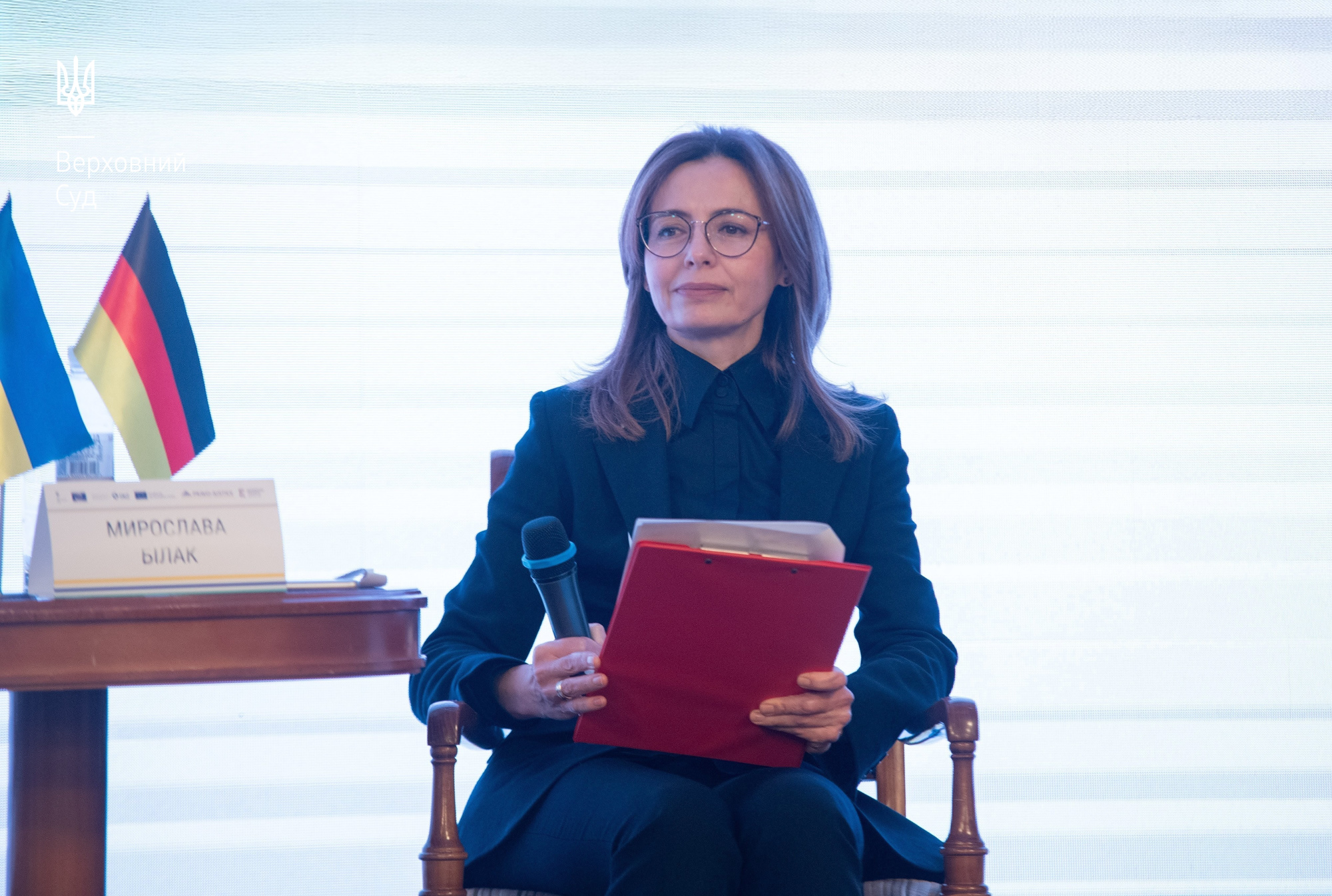
The moderator of the workshop - Supreme Court judge at the Administrative Cassation Court Myroslava Bilak - noted that the event is a logical continuation of a series of thematic seminars launched by the Supreme Court in 2019, aimed at exchanging professional experience and legal approaches with foreign experts on the protection of constitutional human rights by administrative proceedings in the context of the implementation of decisions of a body of constitutional jurisdiction, the legal consequences of declaring a regulatory act unconstitutional, the application of the norms of the Fundamental Law as norms of direct effect, as well as the resolution of court cases in wartime in compliance with constitutional requirements regarding the limits and cases of restrictions on human rights. All these matters are linked to the provisions of part four of Article 7 of the Code of Administrative Procedure of Ukraine, which confirm that in Ukraine administrative courts exercise incidental review in connection with a specific case in which a particular provision of a legal act is applied and may contradict the Constitution. Therefore, Myroslava Bilak emphasized, the protection of the rights of an individual who comes to court experiencing a sharp sense of injustice in the observance of their rights and guarantees - especially social rights - directly depends on the outcomes of today’s discussion.
As part of the event, an introductory lecture on the potential for improving interaction and enhancing the effectiveness of constitutional and administrative justice as means of legal protection of human rights in public law relations was delivered by Mykola Gnatovskyy, Judge of the European Court of Human Rights elected in respect of Ukraine.
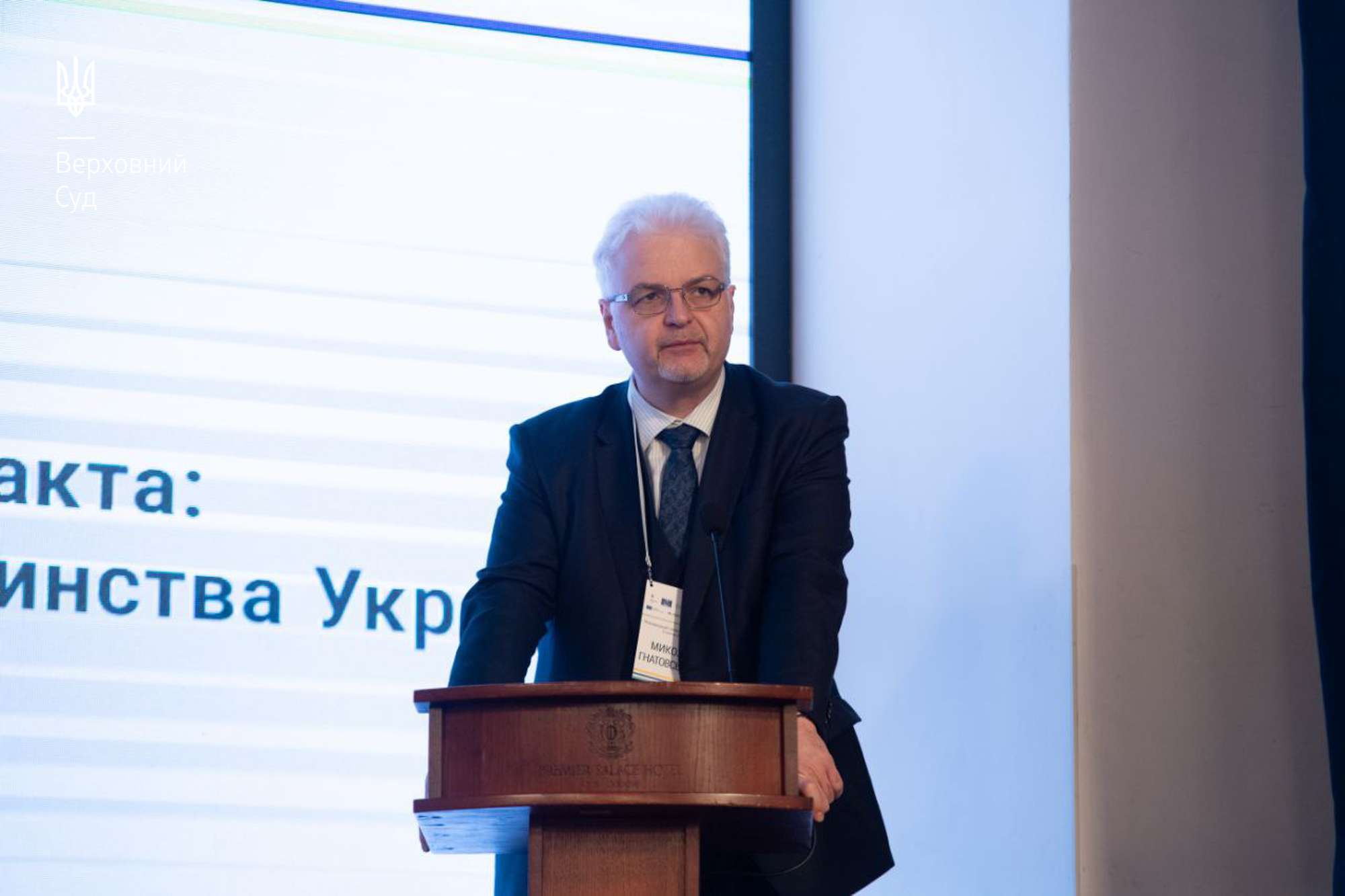
He explained that the situation regarding the protection of human rights in a particular state is determined by the number of applications lodged against that state alleging violations of rights guaranteed by the Convention for the Protection of Human Rights and Fundamental Freedoms and its Protocols. To achieve a low number of applications to the ECtHR against a state, there are two main approaches. The first is to avoid, as much as possible in the activities of public authorities, situations in which Convention-guaranteed human rights may be violated. The second approach, which allows trends to be traced more clearly, lies in the availability of effective remedies at the national level.
“When such remedies are lacking, individuals do not find protection at the national level and turn to the ECtHR even in respect of trivial violations of Convention rights and freedoms. Therefore, interaction between national and international judicial bodies is key, and at the national level this primarily falls within the responsibility of administrative and constitutional courts,” the ECtHR judge noted. According to him, one example of a state where administrative justice is extremely well developed and effective, and where constitutional justice likewise functions in a highly coordinated manner and for the benefit of society, is Germany. To achieve such results within the framework of administrative proceedings, Mykola Gnatovskyy believes that legislation is needed to enable administrative courts to actually work and apply the provisions of the Constitution and the Convention as directive norms. Clear and comprehensible legislative regulation of the algorithms for determining compensation for persons who have suffered from violations of their rights by the state is also necessary.
With regard to constitutional justice, the speaker emphasized the need to recognize that a constitutional court is an essential element in the proper functioning of the state; it is a body designed to ensure the effectiveness of the constitution, the state’s compliance with its international obligations, and a necessary component of a system that operates in a manner that makes it ready for accession to the EU. In addition, Mykola Gnatovskyy noted that the institution of the constitutional complaint must be full-fledged and effective so that the constitutional court can complement and support administrative jurisdiction. This will make it possible to fully realize the potential of constitutional and administrative justice in the protection of human rights.
Information about the presentations of all speakers at the International Seminar-Workshop “Determining the Constitutionality of a Law or Other Legal Act: Who is Competent under Article 7 of the Code of Administrative Procedure of Ukraine” will be published later on the communication platforms of the Supreme Court.
.jpg)
_03_03.png)