Contact center of the Ukrainian Judiciary 044 207-35-46
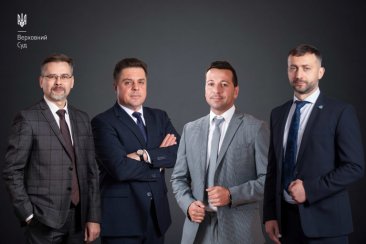
Which country’s court may hear a divorce case involving a foreign spouse? Who may apply to a court for a restraining order in cases of domestic violence against a child? What is the role of hearing a child’s views in proceedings concerning their interests? What trends can be observed in inheritance disputes? These issues were discussed by Serhii Pohribnyi, Judge of the Grand Chamber of the Supreme Court, and Supreme Court judges of the Civil Cassation Court Yevhen Synelnykov, Pavlo Parkhomenko, and Vladyslav Shypovych at the 3rd Family and Inheritance Law Forum organised by the Ukrainian Bar Association.
Serhii Pohribnyi delivered a presentation titled “Family Disputes: Cross-Jurisdictional Issues”. He addressed the question of determining the state whose law should be applied when resolving a divorce dispute involving a foreign element, noting that in such cases courts must be guided by Articles 75 and 76 of the Law of Ukraine “On Private International Law”.
The speaker analysed the resolution of the Civil Cassation Court of the Supreme Court of 24 July 2020 in case No. 357/12676/18. In that case, a U.S. citizen filed a claim for dissolution of marriage with a Ukrainian citizen before a Ukrainian court. The defendant sought to have the case heard in the United States, where the spouses had also resided for some time. The SC CivCC noted that Ukraine and the United States do not have an international treaty on legal assistance in civil and family matters. Since the defendant permanently resided in Ukraine at the time the divorce claim was filed, and the plaintiff, by applying to a Ukrainian court, accepted its jurisdiction to resolve the divorce dispute, the court of first instance legitimately opened proceedings at the defendant’s place of residence and adjudicated the case on the merits, in accordance with para. 2 of part 1 of Article 76 of the Law of Ukraine “On Private International Law”.
The SC CivCC concluded that Ukrainian law, applied under the lex fori principle, governs the substantive legal relations in determining the grounds for dissolution of marriage.
The judge also drew attention to certain issues concerning the application of the Convention on the Civil Aspects of International Child Abduction (Hague Convention 1980) and the Convention on Jurisdiction, Applicable Law, Recognition, Enforcement and Co-operation in Respect of Parental Responsibility and Measures for the Protection of Children (Hague Convention 1996).
Serhii Pohribnyi analysed the resolution of the SC CivCC of 17 August 2022 in case No. 613/1185/19. In that case, the father asked the court to return his minor children to their previous place of residence in Ukraine after they left the country with their mother for the Republic of Armenia. The Court considered whether such disputes fall within the jurisdiction of Ukrainian courts and, if so, under what conditions.
The Court pointed out that in order to decide whether the case is subject to consideration by the courts of Ukraine, it is necessary to find out:
1) whether the children’s habitual residence was in Ukraine before they were taken abroad;
2) whether the children have established a new habitual residence outside Ukraine;
3) whether the children have become settled in the new environment;
4) if it is impossible to determine the children’s habitual residence, in which state they are currently located as a result of the relocation.
Presentation by Serhii Pohribnyi – https://court.gov.ua/storage/portal/supreme/prezentacii_2025/Prezent_Simeinu_sporu_interjurisd_sporu.pdf
In his presentation “Protecting Children from Violence (Restraining Order)”, Yevhen Synelnykov noted, in particular, that children may be victims, witnesses, and also perpetrators of violence. Experiencing violence in childhood may have long-term consequences. In addition, children may be subjected to discrimination on the grounds of physical disabilities, race, sexual identity, religion, their own addictions, or the addictions of their parents.
If the state (the court) fails to respond effectively and ensure protection of victims of domestic violence in situations of immediate threat to their life, liberty, or health, this may lead to a violation of the prohibition of discrimination combined with a violation of the right to life and/or the prohibition of inhuman or degrading treatment, the right to private and family life, and the right to the protection of personal data.
Part 2 of Article 26 of the Law of Ukraine “On Preventing and Combating Domestic Violence” establishes the means by which a court may influence the perpetrator. At the same time, any behaviour that causes harm (as assessed by the court) may become legally prohibited through a court decision imposing a restraining order.
A court decision containing a restraining order is a swift (consideration within 72 hours; court expenses covered by the state) and effective means of protecting victims of domestic violence (immediate enforcement). The measures applied by the court must be effective, deterrent, and proportionate.
The speaker noted that in France and the United Kingdom, temporary protection orders and non-molestation orders are issued by a family court judge (a judge with the relevant specialisation). This allows a victim to obtain protection for themselves and their children quickly (within weeks). Applications may be filed and considered ex parte / without notice on the same day in order to prevent further violence. The court applies protective measures immediately but temporarily; a second hearing is then held, with both parties present and evidence assessed, after which the court issues a final decision. In England, the court may, on its own initiative, issue a child protection order in any family dispute, including an order for the removal (seizure) of a child.
Yevhen Synelnykov cited the resolution of the Civil Cassation Court of the Supreme Court of 16 June 2021 in case No. 369/13467/20. In this case, a minor (15 years old) applied to the court claiming that he had been subjected to domestic (psychological) violence by his mother. The Cassation Court concluded that a minor who has reached the age of 14 may enter into a contract with an attorney with the consent of their parents (adoptive parents) or guardians. However, the absence of such consent does not nullify the legal consequences of concluding such a contract or the attorney’s authority to act as a representative, except in cases where the contract is declared invalid by a court.
The judge also drew attention to the resolution of the Civil Cassation Court of the Supreme Court of 12 February 2025 in case No. 718/1695/21. The court established that unlawful actions had been committed against the boy, causing harm to his mental, somatic, and psycho-emotional condition. In this case, a separate ruling was issued drawing the attention of the Children’s Services to the need for appropriate response and measures aimed at preventing and detecting cases of child abuse.
Presentation by Yevhen Synelnykov – https://court.gov.ua/storage/portal/supreme/prezentacii_2025/Prezent_Zahust_ditej_nasulstvo.pdf.
While presenting “National Practice in Implementing Article 12 of the Convention on the Rights of the Child”, Pavlo Parkhomenko stated that this article guarantees a child’s right to be heard in any judicial or administrative proceedings affecting their interests. The speaker noted that this is a fundamental right on which the Convention on the Rights of the Child is built. It has been implemented in the practice of national courts.
The judge drew attention to General Comment No. 12 of the UN Committee on the Rights of the Child dated 20 July 2009, “The Right of the Child to Be Heard”. It states that:
In addition, the Committee emphasized that Article 12 of the Convention on the Rights of the Child does not set any age limit regarding a child’s right to express their views. It does not encourage States Parties to introduce, either in legislation or in practice, age restrictions that would limit a child’s right to be heard on all matters affecting their interests (para. 21).
Pavlo Parkhomenko drew attention to the ECtHR judgment of 27 September 2018 in Y.B. and N.S. v. Belgium. The Court noted, in particular, that a child’s young age or the vulnerability of their situation (for example, disability, belonging to a minority, migrant status, etc.) does not prevent the exercise of their right to express their views and does not diminish the importance of those views when determining the child’s best interests.
The speaker analyzed the ruling of the Civil Cassation Court of the Supreme Court of 17 July 2019 in case No. 185/6994/15-ц, which set out conclusions on the procedure for determining the child’s views. It states that when a court seeks to hear a child’s opinion in order to determine their preference regarding residence with one parent, and to avoid psychological harm or undue pressure, it may instruct childcare and guardianship authorities to conduct an informal interview with the child at home or in another comfortable setting and report the results to the court.
In its resolution of 19 June 2024 in case No. 372/3402/22, the Court concluded that the ways to implement this right may include: hearing the child directly in the courtroom; obtaining information on the child’s views from the opinion of the childcare and guardianship authority, an expert, and/or a specialist. In its resolution of 16 February 2024 in case No. 465/6496/19, the Court stated that the court must consider the child’s expressed views in a systematic manner, properly examining the factual circumstances of the case. Only in this way can the child’s best interests be ensured, rather than the interests and wishes of the parents.
Pavlo Parkhomenko's presentation is available at – https://court.gov.ua/storage/portal/supreme/prezentacii_2025/Prezent_Nac_prakt_st12KPD.pdf
Vladyslav Shypovych delivered a presentation titled “Inheritance Disputes: Trends in Judicial Practice”.
He presented judicial statistics showing that in 2024, the number of inheritance-related cases pending before local courts amounted to 47,824 (compared to 41,844 in 2023), with 27.4% remaining unresolved at the end of the year (29.3% in 2023). He also noted that, in quantitative terms, court disputes regarding inheritance by will and inheritance by law are in a ratio of approximately one to three.
Using examples from specific Supreme Court resolutions, the speaker outlined three main trends in inheritance disputes: 1) freedom of testament and respect for the testator’s will; 2) good faith and diligence in exercising rights; 3) ensuring the stability of civil circulation.
Regarding the freedom of testament and respect for the testator’s will, Vladyslav Shypovych drew attention to the resolution of the Grand Chamber of the Supreme Court of 25 May 2021 in case No. 522/9893/17, which addressed the legal consequences of a will certified by a notary outside their notarial district; the resolution of the Joint Chamber of the Civil Cassation Court of the Supreme Court of 29 January 2024 in case No. 369/7921/21 concerning a will certified by an official of a village council; the resolution of the Civil Cassation Court of the Supreme Court of 23 September 2020 in case No. 572/3771/18 concerning a will certified by an on-duty hospital doctor; and the resolution of the Civil Cassation Court of the Supreme Court of 20 July 2022 in case No. 461/2565/20 regarding certification of a will for a person with physical impairments preventing them from reading the will.
The speaker illustrated another trend in inheritance disputes – good faith and diligence in exercising rights – using cases related to granting additional time to submit a declaration of acceptance of inheritance. In particular, he analyzed the resolution of the Civil Cassation Court of the Supreme Court of 19 June 2024 in case No. 179/417/22, initiated by the testator’s daughter who claimed she was unaware of her father’s death; and the resolution of the Civil Cassation Court of the Supreme Court of 20 March 2024 in case No. 545/1231/23 involving an heir living in an active combat zone. He also highlighted the conclusions of the Grand Chamber of the Supreme Court in its resolution of 26 June 2024 in case No. 686/5757/23 concerning situations where an heir’s lack of awareness about the existence of a will cannot be considered a valid reason for missing the deadline to accept the inheritance, as well as the resolution of the Joint Chamber of the Civil Cassation Court of the Supreme Court of 2 June 2025 in case No. 201/14368/15-ц regarding the procedure for exercising inheritance rights by a person named in a bank’s (financial institution’s) testamentary disposition.
Discussing the issue of ensuring the stability of civil circulation in the resolution of inheritance disputes, the speaker referred to Supreme Court resolutions that distinguished between the legal constructs of “amending a certificate of inheritance rights” and “invalidating a certificate of inheritance rights”; addressed issues of escheated (unclaimed) inheritance and claims for recovery of property; and considered the validity of mortgages for heirs of a mortgagor.
Presentation by Vladyslav Shypovych – https://court.gov.ua/storage/portal/supreme/prezentacii_2025/Prezent_Spadkovu_sporu_tendencii.pdf
_03_03.png)