Contact center of the Ukrainian Judiciary 044 207-35-46
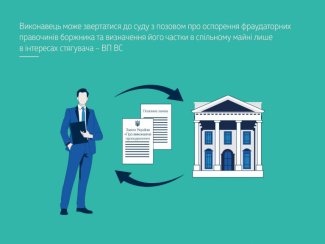
If, however, a claim is filed in the interests of the debtor, such a statement of claim must be returned to the applicant without opening proceedings in the case. If this is established after proceedings have been opened, the claim must be left without consideration.
Rulings of the court of first instance that prevent further proceedings in a case (in particular, on returning a claim to the plaintiff), after being reviewed on appeal, are subject to cassation appeal regardless of the outcome of their review by the appellate court.
This is the conclusion of the Grand Chamber of the Supreme Court.
In the circumstances of the case, while executing a court decision to recover a debt from the debtor, a private enforcement officer discovered that the debtor had no property of her own to satisfy the debt. At the same time, it was established that during their marriage, the couple had acquired a plot of land and a residential house registered in the husband’s name. After the loan repayment term had expired, the spouses concluded a prenuptial agreement stipulating that any property acquired during the marriage would be the personal property of the spouse in whose name it was registered. Following their divorce, the husband gifted the land and house to their daughter.
According to the private enforcement officer, these agreements were concluded by the debtor to the detriment of the creditor, with the intent to prevent enforcement against the property — that is, they were fraudulent transactions. This became the basis for filing a lawsuit seeking to declare the transactions invalid and to determine the debtor’s share in the jointly owned property.
The court of first instance returned the private enforcement officer’s claim, filed in the interests of the debtor, on the grounds that the Law of Ukraine “On Enforcement Proceedings” does not grant state or private enforcement officers the authority to file claims in court on behalf of either the creditor or the debtor in enforcement proceedings. The appellate court upheld the private enforcement officer’s appeal, canceled the first-instance ruling, and remanded the case for further consideration by the first-instance court.
In reviewing the judicial decisions, the Grand Chamber of the Supreme Court emphasized that an enforcement officer, when conducting enforcement proceedings, has not a personal but an exclusively official interest, which consists in fulfilling the duties assigned to them by the state and achieving the result whereby the court’s decision is duly executed.
The activities of an enforcement officer are determined by the need to uphold the principles of legality and the rule of law, rather than by the interests of a specific party to the enforcement proceedings. Ensuring the most favorable conditions for the enforcement of a court decision serves not only the interests of society - which is naturally interested in maintaining law and order in the state - but also the property or non-property interests of the creditor in the enforcement proceedings.
Therefore, an enforcement officer is entitled to file claims with the court to determine the debtor’s share in jointly owned property and to challenge a fraudulent transaction only in the interests of the creditor (and not the debtor) within enforcement proceedings.
At the same time, if an enforcement officer files a claim in the interests of the debtor, this results either in the return of the statement of claim to the applicant pursuant to paragraph 4 of part 4 of Article 185 of the Civil Procedure Code of Ukraine, or - if proceedings have already been opened - in the claim being left without consideration under paragraph 2 of part 1 of Article 257 of the Civil Procedure Code of Ukraine.
Accordingly, the court of first instance correctly concluded that the statement of claim filed by the enforcement officer in the interests of the debtor should be returned.
In this context, by concluding that the appellate court’s ruling should be annulled and the first-instance court’s decision upheld, the Grand Chamber of the Supreme Court confirmed that a ruling of the court of first instance to return a statement of claim to the plaintiff, which had been annulled by the appellate court with the case remitted for further consideration, may be subject to cassation review.
At the same time, the Grand Chamber of the Supreme Court emphasized that the rulings of courts of first instance listed in paragraph 2 of part 1 of Article 389 of the Civil Procedure Code of Ukraine (part 2 of Article 328 of the Code of Administrative Procedure of Ukraine, paragraph 2 of part 1 of Article 287 of the Commercial Procedure Code of Ukraine), after their appellate review, are subject to cassation appeal regardless of the outcome of their review by the appellate court.
Resolution of the Grand Chamber of the Supreme Court of September 10, 2025, in case No. 367/252/24 – https://reyestr.court.gov.ua/Review/130552487.
This and other legal positions of the Supreme Court can be found in the Database of Legal Positions of the Supreme Court - https://lpd.court.gov.ua.
_03_03.png)